US Election

US Election 2024: Map the Vote, post-election

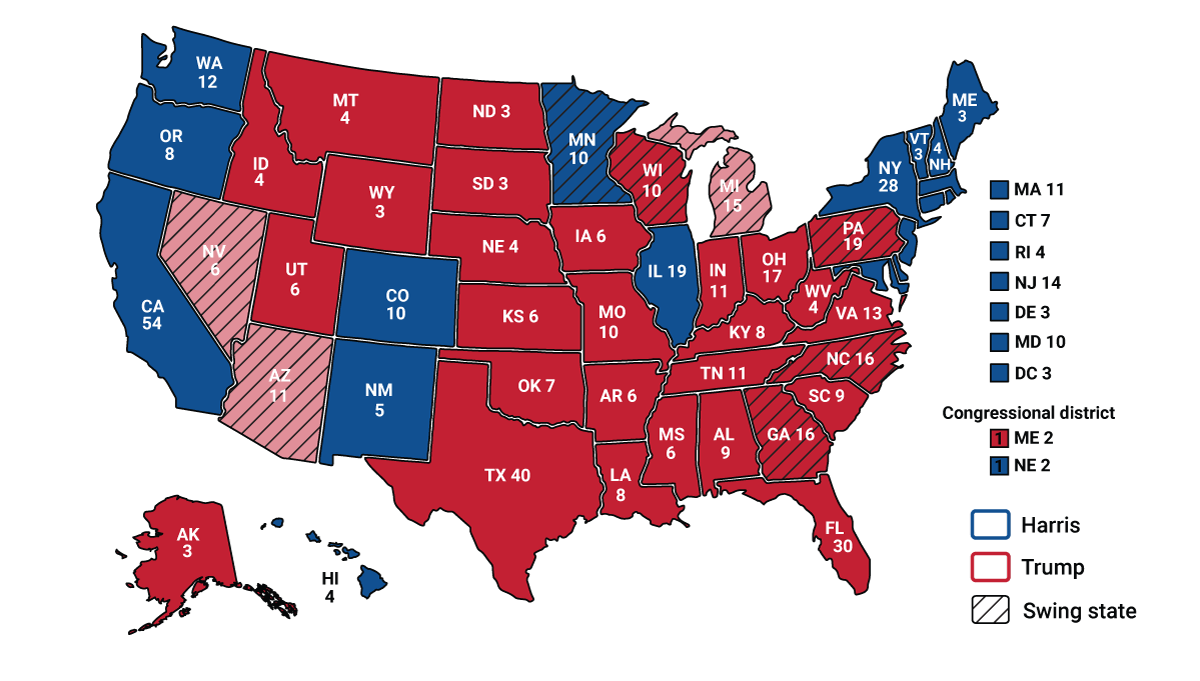
2024 US Election electoral map showing states won by Trump and Harris as of November 6 2024

The results are in, with a big win for Donald Trump and the Republican party. We've filled in the US map with the states and electoral votes won as of November 6th at 11 AM, according to AP News.

Yesterday, we offered you all a downloadable map to track the 2024 presidential election race and count the number of electoral votes earned by each candidate. You can still download the blank map below to fill it in as the final state races are officially called.

Print it or just download it to your mobile device to keep your own tally of the US electoral count per state as the results are called. Each state's number of electoral votes is shown below. Maine and Nebraska have a split system of electoral votes, so we've listed the two split votes for each to the right of the main map. The swing states are indicated with a patterned background. A presidential candidate needs at least 270 electoral votes to win the election.

GZERO+Election+Day+map.pdf


For more background, check our our explanation about the 15 key counties that could determine the outcome, and everything you need to know about the 7 swing states that could decide the election.

Make sure to check GZERO's ongoing election coverage to find out the latest, and join us on Wednesday at 11 am ET for our X Space day-after debrief to discuss the results.

US Election 2024: Map the Vote!


More For You

German Chancellor Friedrich Merz, French President Emmanuel Macron and British Prime Minister Keir Starmer sit at the start of the E-3 meeting, during the Munich Security Conference (MSC), in Munich, Germany, on February 13, 2026.
Thomas Kienzle/Pool via REUTERS

Until now, Europe has kept out of the Iran war. But with Iran attempting to hit the UK island of Diego Garcia on Friday, and fears growing that US President Donald Trump will forget about Ukraine, that calculus may have changed.

Cyber threats to water and wastewater systems are no longer hypothetical, and they pose real risks to public health, economic stability, and community trust. In collaboration with the Cyber Readiness Institute (CRI) and the Center on Cyber Technology and Innovation (CCTI), Microsoft released new findings showing that cybersecurity training alone isn’t enough to close the readiness gap in the water sector. Drawing on a pilot program, the report finds that pairing accessible training with hands‑on coaching significantly improves cyber resilience, especially for smaller and resource‑constrained utilities. The takeaway is clear: moving from awareness to preparedness requires practical, trusted support—not just guidance—offering a model that could strengthen cybersecurity across other critical infrastructure sectors as well. Read the full blog here.