A month into Russia’s invasion of Ukraine, I find my mind wandering to the moment 30 years ago when I began my life as a political scientist. Because believe it or not, it all started in Ukraine.
It was Lenin who first described Tsarist Russia as a Тюрьма народов, a “prison of nations.” In the late 1980s, nothing interested me more than the nationalities trapped inside the USSR. I started work on my PhD in 1989, when the most interesting story in the world was the fall of the Berlin Wall and the beginning of the end of the Soviet empire. It was a moment when nationality questions within that empire looked set to explode. And then they did.
So that became the focus of my research. And when it came time to sharpen my focus, I decided on the study of ethnic Russians living inside what was then the Ukrainian Soviet Socialist Republic… and later the independent nation of Ukraine.
My dissertation, completed in 1994, was “The Politics of Ethnicity: Russians in the new Ukraine.” Seriously.
Want to understand the world a little better? Subscribe to GZERO Daily by Ian Bremmer for free and get new posts delivered to your inbox every week.
At the time, the central debate in international relations theory was the idea of a coming “clash of civilizations,” a concept championed by Harvard professor Samuel Huntington. The idea went like this: The Cold War is over. The new fault-lines among nations will now be “civilizational” rather than ideological. There is a Western civilization, an Orthodox civilization, Islam, Hindu, Chinese, etc. These are the new boundaries.
I wasn’t the only person who dreaded the sound of that. I hoped my research might uncover evidence to help prove that this famous grand theory was simply wrong. (That’s a lot to ask of a PhD thesis, but I was a kid.) And I knew I was standing in an ideal place to test the theory. An empire was coming apart over a period measured in weeks. The great black box was opening. One nation is becoming 15 nations right in front of us! The Communist true believers I knew, and those I read, liked to talk about the role of history in shaping who we are… and suddenly history was moving fast enough for us to watch as it lurched forward. In real time.
Outside Russia, all these former Soviet Socialist Republics were “ethnoterritorial administrative divisions,” republics that were demarcated on the basis of the ethnic identity of the majority population on the ground there: Uzbekistan for Uzbeks, Estonia for Estonians, Azerbaijan for Azerbaijanis, etc.
And Ukraine.
And from my point of view, the most interesting bit of all was that there were ethnic Russians, the dominant nationality in the dominant republic, who abruptly found themselves living in foreign countries – former Soviet states where they instantly became an ethnic minority. In fact, with the exception of Armenia, where Russia’s made up a tiny fraction of the population, all the new nations had ethnic Russian minorities that made up of more than 5 percent of the population. In a couple of cases, including Ukraine, the percentage was much higher.
So, here was the question: Will there be a clash of civilizations in those republics where a Russian Orthodox minority comes into conflict with a majority that is not Orthodox or even Christian? (Does it matter that all these places were officially atheist two years ago?) I started travelling across these republics to find out. I went to Kazakhstan, Kyrgyzstan, Uzbekistan, Georgia, and Armenia.
And then in 1992-1993, I spent a year crisscrossing Ukraine.
I went to Kyiv, which we still called Kiev. I went to Lviv, a city in Ukraine’s far west. I went to the eastern city of Kharkiv, where Russian was the dominant language, even for ethnic Ukrainians. I went to Dnipropetrovsk, to Southeast Ukraine, and to Crimea, where I asked ethnic Russians and ethnic Ukrainians (and Muslim Tatars, as well) how they thought of their role in the new country of Ukraine.
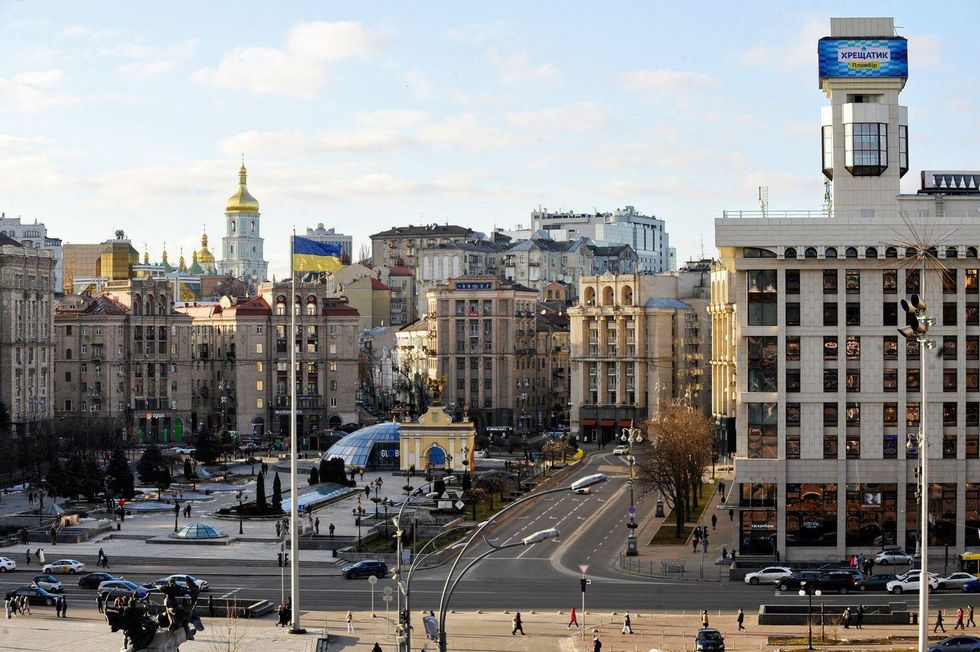 Kyiv Pre-russia invasion
I didn’t expect to find much civilizational divide. If there was conflict, I imagined, it’s far more likely in Kazakhstan along religious lines than in a place like Crimea where people look more or less the same and even speak with similar accents. In fact, in Southeast Ukraine, I heard a dialect that was a mix of the Russian and Ukrainian languages.
And yet… in Crimea and Southeast Ukraine, the parts of Ukraine with the biggest percentage of ethnic Russians, many of the Russians I spoke with told me they felt they were still living in “greater Russia.” Their people had lived there for many centuries, and their identification with Russia was very strong. The vast majority of people I spoke with in Crimea wanted either the Soviet Union to come back or to become part of Russia. This was, and remains, a blind spot for many Americans and even Europeans. Before 2014, Crimea was an autonomous republic inside Ukraine with its own parliament and with a tricolor flag flying above it. Almost everybody spoke Russian.
But here’s where Vladimir Putin has a blind spot of his own. Even in 1992, the rest of Ukraine felt very different from Crimea. And that was before two revolutions and the current war, three events defined by Ukraine’s bid to escape Russia’s shadow. Even 30 years ago, many more people in Kiev immediately identified themselves as Ukrainian in sensibility, though divides were apparent. And the farther you moved to the west, the less Russia featured in responses. Lviv was so recently part of Poland that older parts of local cemeteries have only Polish grave markers. There was virtually no identification with Russia. Yet, Putin seems surprised. (I should have sent him a copy of my thesis.)As for Huntington, the trend I spotted in my research was true well beyond Ukraine. In Kazakhstan, the pattern was the same. The feeling that ethnic Russians living there had about the idea of a country called Kazakhstan varied by region and how long Russians had lived there. In the north, Russians felt at home and thought of themselves as living in Russia. In the south, even in the capital, then called Almaty, it was clear that Russia was far away. There was no clash of Russian Orthodox vs Muslim, and there is no sign of any such emerging clash today.
The worst fighting we've seen in the former Soviet space is between Russians and Ukrainians. Though they’re virtually identical ethnically, Putin’s invasion is creating a strong Ukrainian national identity. Even Sam Huntington would see the irony of that.
🔔 And if you haven't already, don't forget to subscribe to my free newsletter, GZERO Daily by Ian Bremmer, to get new posts delivered to your inbox.