VIDEOSGZERO World with Ian BremmerQuick TakePUPPET REGIMEIan ExplainsGZERO ReportsAsk IanGlobal Stage
Site Navigation
Search
Human content,
AI powered search.
Latest Stories
Sign up for GZERO Daily.
Get our latest updates and insights delivered to your inbox.
Puppet Regime is up for a Webby Award!
VOTE HERE
Past Events
Watch our recent livestream events: live panel discussions, town halls and summits with global experts and leaders.
Presented by
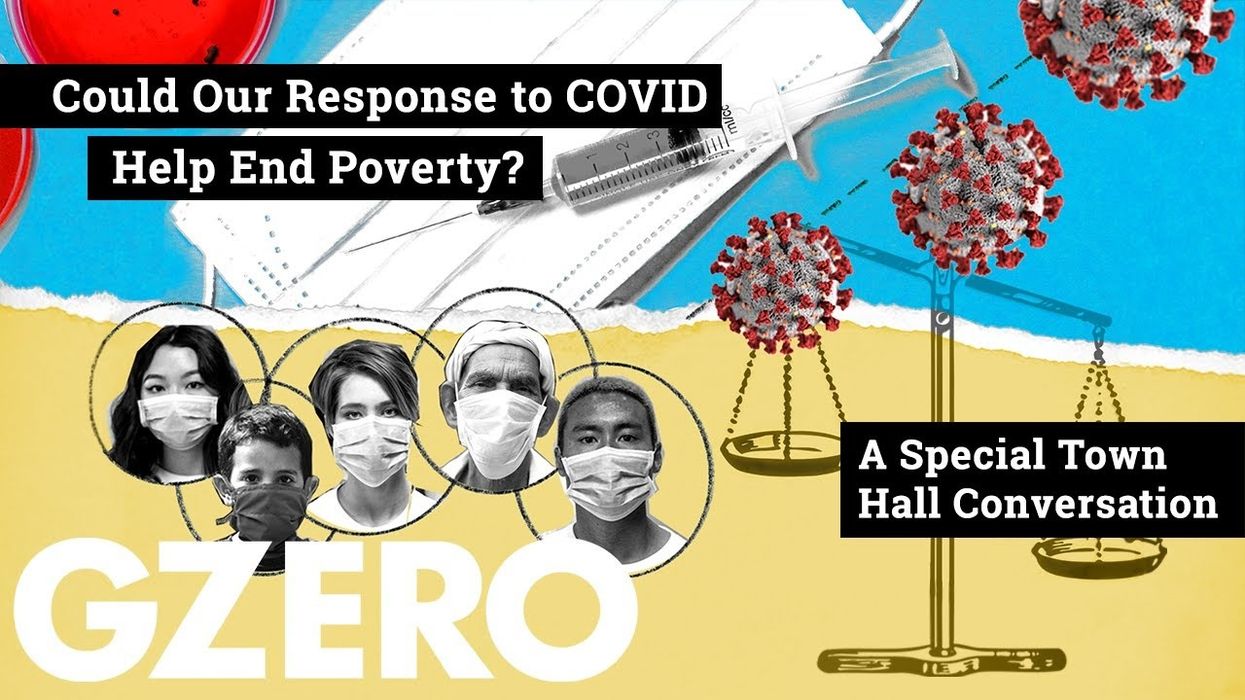
GZERO Media, in partnership with the Bill and Melinda Gates Foundation and Eurasia Group, today hosted its first virtual town hall on how to fight global poverty amid the coronavirus pandemic.
The panel featured Gates Foundation CEO Mark Suzman, Eurasia Group and GZERO Media President Ian Bremmer, and Vera Songwe, Executive Secretary of the United Nations Economic Commission for Africa. The conversation was moderated by Africa No Filter's Moky Makura.
Watch the full video above.
Has the pandemic strengthened or weakened multilateral organizations?
Songwe:
- It has reinforced and strengthened them, not weakened them, by creating space for larger collaborative platforms. At the UN, we are bringing in some of the leading economists and think tanks in the world to think about how we can respond to this crisis differently. Questions about inclusion and participation are already starting to come to the table, as the UN's open platform brings in civil society voices on this subject. The World Health Organization has been a shining light, guiding us in terms of the scientific evidence, while other institutions, like the Centers for Disease Control in Africa and elsewhere, have been particularly important.
- But resources are slim. We need to shore these multilateral institutions with more professional and scientific staff, as well as more financing for the International Monetary Fund and the World Bank, so they can respond in a timely manner to the economic aspect of this crisis.
How do we ensure that if a COVID-19 vaccine is developed, it can reach every corner of the globe?
Suzman:
- Let polio be an example. Last week, Africa was officially declared polio-free by the WHO, meaning the only parts of the world that still have the disease are Afghanistan and Pakistan. That shows you what can be done, even in very challenging logistical environments. The world knows how to do it. GAVI, the Vaccine Alliance, has probably saved more lives in the last 20 years than any collaborative effort in human history. I'm relatively optimistic. It is challenging, but we know how to do it. We have the constructs, we have the supply chains, we have the health systems.
- What we don't have is the money and resources to be able to procure at scale in sufficient volume. What is equitable distribution and how do you do it rapidly at a time when so many individual countries may try to lock up supply for their own citizens. It's an understandable impulse, but there's a risk that this kind of "vaccine nationalism" actually sets the world back.
Should low- and middle-income countries be entitled to debt relief amid the pandemic?
Bremmer:
- Sure, but under what conditions? Austerity-based reforms that Western economists believe will create more sustainable long-term growth can cause enormous hardship for populations that you don't really want to hurt. Loans are also often attached to political reforms — and that's where China is going to be critical to the debt relief equation, particularly in sub-Saharan Africa, where Beijing isn't going to demand the same kind of economic or political liberalization in exchange for support. Frequently the Chinese conditions are much more opaque, sometimes beholding these countries to China's economic and political interests, which may not be good for either the world or these countries' populations.
- I think we have to worry that as the global order is fragmenting, especially as the US and China are at much greater odds with each other. We could well be fighting over conditionality and debt for some of the most vulnerable countries, and that's something that we're going to have to pay attention to.
Keep reading...Show less
More from Past Events
How to prepare the global economy for the age of AI
April 15, 2026
How the Iran war made China stronger
April 15, 2026
Another milestone for a bleak civil war
April 15, 2026
A full-stack approach to AI
April 15, 2026
Hard Number: Saudi Arabia picks up Pakistan’s tab again
April 15, 2026
What’s Good Wednesday, April 15th, 2026
April 15, 2026
The next phase of AI is physical
April 15, 2026
How AI offsets Trump’s tariffs...for now
April 14, 2026
Hard number: School shooting in Turkey
April 14, 2026
Has far-right populism peaked in Europe?
April 14, 2026
Quick Take
Apr 13, 2026
Graphic Truth: The human toll of the Iran war
April 13, 2026
Hard Number: Canada’s Carney finally set for majority
April 13, 2026
GZERO World with Ian Bremmer
Apr 12, 2026
Ian Explains
Apr 10, 2026
Hard number: No spring breaks in Europe?
April 10, 2026
You vs. the News: A Weekly News Quiz - April 10, 2026
April 10, 2026
Krastev: The Iran war is fracturing Europe's far right
April 09, 2026
How China is supplying America’s “biohacking” craze
April 09, 2026
Hard number: Russia’s oil windfall
April 09, 2026
Viktor Orban will probably lose. What then?
April 08, 2026
Why are car buyers pumping the breaks?
April 08, 2026
What’s Good Wednesday April 8th, 2026
April 08, 2026
Hard number: Cuba gets bigger bills for bigger problems
April 08, 2026
ask ian
Apr 08, 2026
Why Orbán's real patron isn't Trump
April 07, 2026
Trump’s new ultimatum for Iran
April 07, 2026
Hard number: Ukraine rips into Russia’s oil windfall
April 07, 2026
Tools and Weapons: In Conversation with Ryan Roslansky
April 07, 2026
Who’s negotiating with Iran to keep trade moving?
April 06, 2026
Hard number: Lunar sphere of influence
April 06, 2026
US defense spending vs. the world
April 06, 2026
How Hungary's Orbán built his empire, and why it's cracking
April 06, 2026
What a Viktor Orbán loss would mean for Trump
April 06, 2026
Puppet Regime
Apr 03, 2026
Vote for Puppet Regime in the Webby Awards!
April 02, 2026
Hard number: AI has college students second-guessing
April 02, 2026
Where US tariffs stand one year after Liberation Day
April 02, 2026
The case against political prediction markets
April 01, 2026
Crypto goes steady
April 01, 2026
What’s Good Wednesday: April 1st, 2026
April 01, 2026
Hard number: 2026 World Cup debuts
April 01, 2026
GZERO Europe
Mar 31, 2026
Empowering nonprofits to meet tomorrow’s challenges
March 31, 2026
Hard number: Eurovision expands to Asia
March 31, 2026
Could the war in Iran reshape the future of energy?
March 31, 2026
The strategy gap in the Iran war
March 30, 2026
Who’s protesting in 2026?
March 30, 2026
Hard number: Masterpieces, masterfully heisted
March 30, 2026
Gender gap in AI job displacement
March 29, 2026
Is Trump losing control of the Iran war?
March 29, 2026
How can AI improve everyday life for citizens?
March 28, 2026
Rahm Emanuel on how the Democrats could blow it in 2028
March 27, 2026
Emanuel: “The last time China fought a naval war? Never”
March 27, 2026
Rahm Emanuel on Trump’s missed drone opportunity
March 27, 2026
Trump’s farm troubles
March 27, 2026
You vs. the News: A Weekly News Quiz - March 27, 2026
March 26, 2026
Preparing the workforce for AI
March 26, 2026
How AI is being used in the Iran war
March 26, 2026
Jury finds social media giants negligent in landmark trial
March 26, 2026
Expanding AI access worldwide
March 25, 2026
Putin & Xi sit with gratitude in new podcast
March 25, 2026
Trump's Iran climbdown wasn't an offramp
March 25, 2026
How can we fix the AI divide?
March 25, 2026
GZERO Series
GZERO Daily: our free newsletter about global politics
Keep up with what’s going on around the world - and why it matters.