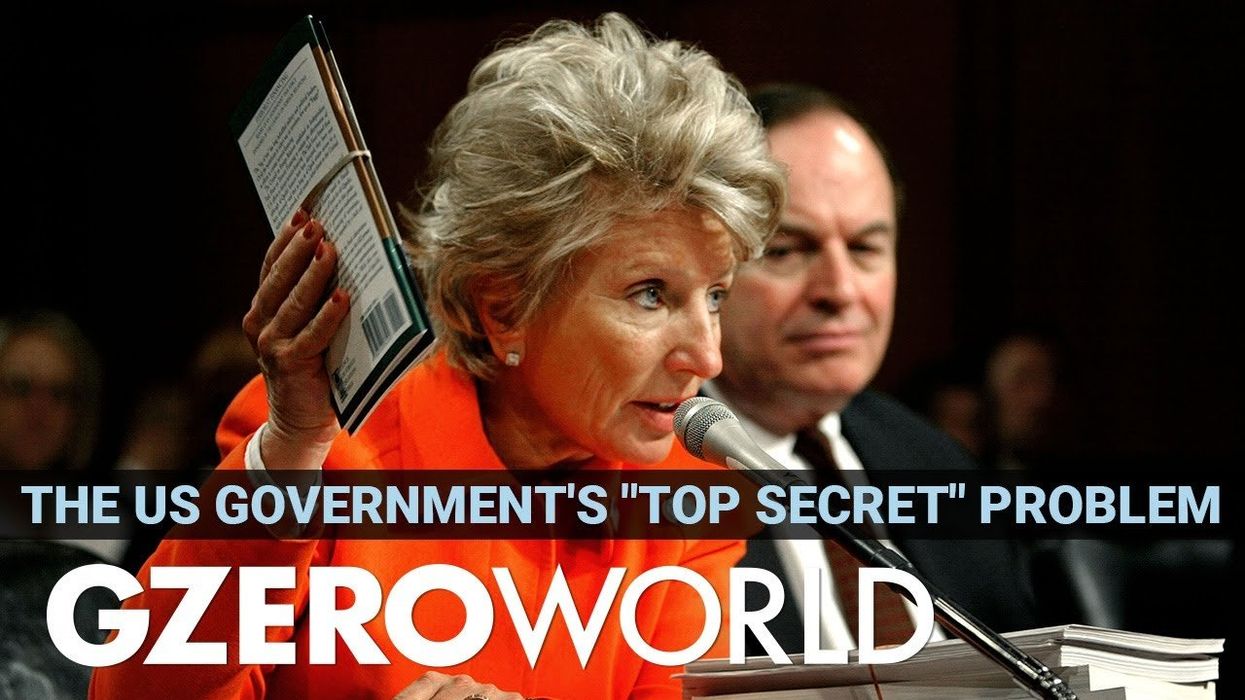
US Government information: What's the threshold for "classified"?
July 18, 2023
Global Stage LIVE from United Nations WATCH REPLAY
Highlights from the GZERO World with Ian Bremmer weekly television show.
There are many reasons for a government to classify information. The US does not want Vladimir Putin getting his hands on our nuclear codes, for example. An estimated 50 million documents are classified every year, though the exact number is unknown—not because it’s classified, but because the government just can’t keep track of it all. But in the words of the former US Solicitor General Erwin Griswold, some “secrets are not worth keeping.”
This week on GZERO World, former Congresswoman Jane Harman argues that America has had for decades an over-classification problem. Harman mentions the findings by the 9/11 Commission, which concluded that a lack of information-sharing between agencies like the CIA, the FBI, and the NSA prevented the US government from foiling the largest terrorist attack ever on American soil. A key reason for that failure: the over-classification of information.
It’s difficult for Americans to understand the actions of their government if much of its work is classified. It also forces journalists to weigh the risks of disclosing information to the public against the possibility of prosecution under the Espionage Act.
Beyond national security concerns, over-classification is also driven by incentives. If you’re a government employee, the risk of classifying something that doesn’t need to be classified is low. But if you un-classify something that you shouldn’t, you're in trouble.
Tune in to “GZERO World with Ian Bremmer” on US public television to watch the full interview. Check local listings.
Every week on GZERO World with Ian Bremmer, Ian explains the key global stories of the moment, sits down for an in-depth conversation with the newsmakers and thought leaders shaping our world.
Watch GZERO World on US public television and on GZERO's YouTube channel. GZERO WORLD with Ian Bremmer is a local public television program presented by THIRTEEN PBS.
Funding for GZERO World is provided by:




Keep up with what’s going on around the world - and why it matters.