Skip to content
Search

Latest Stories

Living Beyond Borders Articles

Can you get by with a little help from your friends?

Can you get by with a little help from your friends?
GZERO Media

The pandemic inflicted a huge shock on supply chains, but there is another force at work remapping global trade flows too: the deepening ideological divide between the US and China, framed in Washington as a broader competition between democracies and autocracies.

The so-called “de-coupling” between the world’s two largest economies began during the presidency of Donald Trump, who slapped tariffs on China in a largely unsuccessful attempt to address the real harms that offshoring has done to some US workers.


But now, as global trade reorients itself in the wake of the pandemic, Washington is making a broader push for US companies to source their goods from factories in friendly democracies rather than authoritarian countries — China, Russia, and the gang — that could use their control over key materials or products to inflict pain on the West. Russia’s use of oil and gas to pressure Europe is one clear example, of course, but there are others: China’s monopoly on the production of rare earths used for electronics, or the precarious concentration of global microchip production in Taiwan, which lives under the constant threat of Chinese invasion.


US Treasury Secretary Janet Yellen recently touted the benefits of so-called “friendshoring” on a visit to South Korea, which is trying to lure American supply chains away from China and to start making more microchips itself. Southeast Asian manufacturing powerhouses like Malaysia, Vietnam, Thailand, and Indonesia are also keen to continue capitalizing as “friends” of the US.

Friendshoring may offer certain protections in a world of deepening ideological competition, but there are tradeoffs: “friendly” countries may not always produce goods as cheaply or efficiently, meaning that consumers may have to accept higher prices, particularly in the short term. Is the tradeoff of greater security in exchange for less efficiency worth it? More to the point, is it now unavoidable?

More For You

The Graphic Truth: ChatGPT breaks the internet
GZERO Media
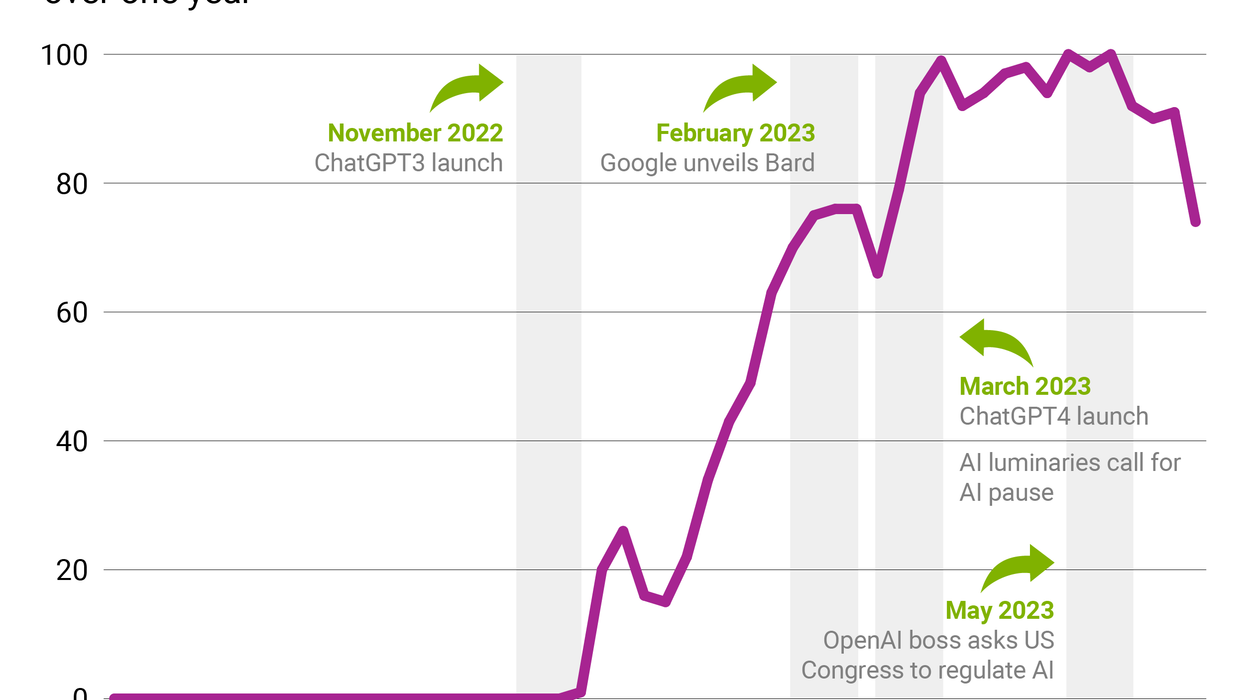
Since ChatGPT, OpenAI's artificial intelligence chatbot, burst onto the scene late last year, AI seems to be everywhere – so much so that it’s become an integral part of our conversations, business dealings, academics, campaign ads, and everything in between.While being faced with constant reminders of AI’s looming threat or promise, most people [...]
An image of a robots.

An image of a robots.

GZERO Media
Whether artificial intelligence will ultimately be good or bad for humanity is an open debate. But there’s another, more immediate issue that often gets lost in the scrum: Even if AI eventually creates more jobs and opportunities than it destroys, what happens to the actual people who lose their jobs on the way to that happier future? And how [...]
AI (Artificial Intelligence) letters and robot hand.

AI (Artificial Intelligence) letters and robot hand.

Reuters
The emergence of AI has amplified the problem of disinformation that has proliferated since the 2016 US presidential election, and regulation is often touted as a way to address this worsening issue. But even if governments do find a way to effectively regulate AI – and that’s a big if – that doesn’t address the widespread demand for conspiracy [...]
A demonstration of robotic arms performing surgery controlled by a doctor that operates remotely using a 5G network in Barcelona, Spain.

A demonstration of robotic arms performing surgery controlled by a doctor that operates remotely using a 5G network in Barcelona, Spain.

Reuters
In years to come, experts tell us that artificial intelligence will alter societies and change individual lives on a scale greater than changes brought about by the creation of the World Wide Web. In the process, AI will create challenges and risks that deserve careful consideration. But headlines that warn of catastrophe are hiding the [...]