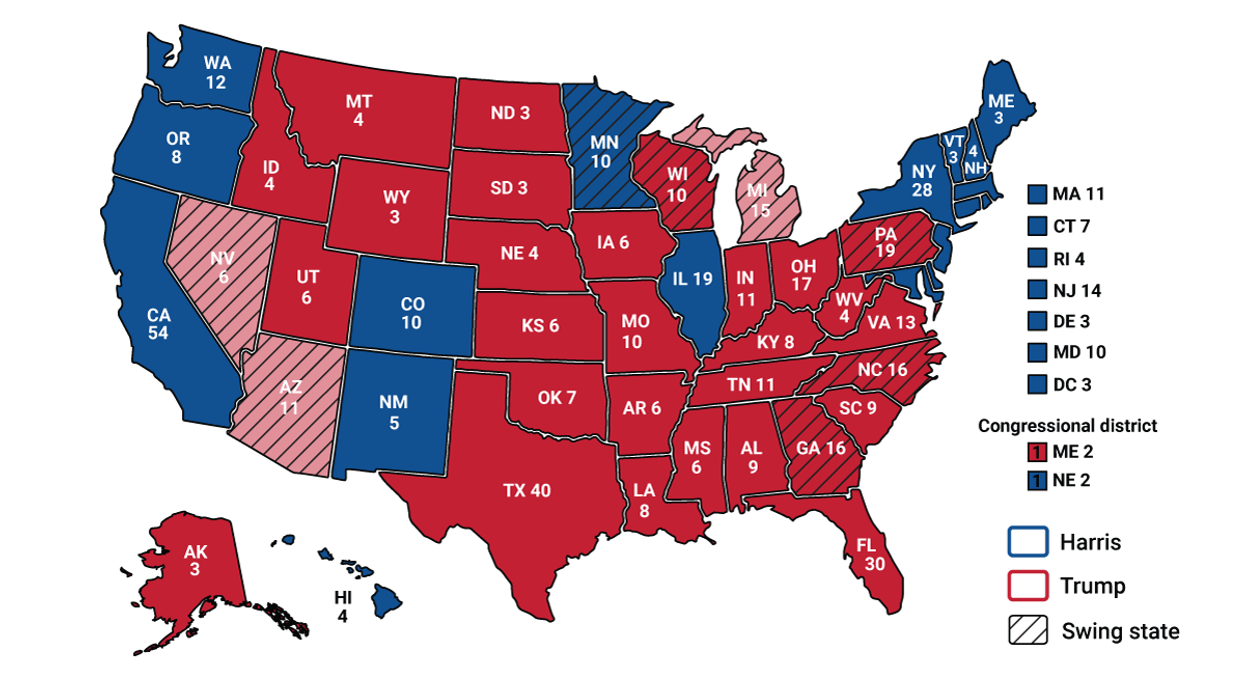
There is a rippling sentiment across Europe that the United States – and therefore the world – faces a “sliding doors” political moment. Will the US soon be led by a familiar face waving a banner of “America First” isolationism, or will it be led by a relatively untested candidate who will likely bring more of the same liberal internationalism long-touted by the Democratic Party?
When asked last week while speaking at Chatham House to fill in the gaps of a Kamala Harris presidency, Speaker Emerita Nancy Pelosi responded: “You are talking about one person, but we’re talking about our country.” And yet, whoever is selected to serve as the 47th US president, this one person, will place the US on a trajectory for the latter half of this decade, and at a pivotal moment in geopolitical history.
Since leaping onto the main stage in late July, Harris has been dogged by questions about her foreign policy experience and potential priorities. From her convention speech to debate performance to a strategically timed Fox News interview, Harris has sought to differentiate herself from Joe Biden’s presidency while still giving a nod to longstanding Democratic policy positions.
Without more meat on the bone being offered by her campaign, watchers from abroad are left scratching their heads about whether Harris is “turning the page,” as she likes to say, or if they will find themselves reading from the same recognizable book of democracy promotion, multilateral cooperation, international institutions, and free markets.
The Democratic playbook has been a work in progress since Donald Trump’s first presidency, swapping out free trade agreements like the Trans-Pacific Partnership for industrial policy and economic tools of national security. Even still, there are clear throughlines from President Barack Obama’s “don’t do stupid stuff” foreign policy to Biden’s “small yards and high fences” approach to what Harris has thus far laid out on the campaign trail. The possibility of policy continuity under Harris provides US allies with a semblance of predictability that feels reassuring.
And for those looking for further insight, Pelosi cautioned: “I know that [Harris] will be well-advised, that there are strong voices for America’s role in the world to keep the world safe. To keep the world democratic.” The risk, though, is that a Harris administration not defined by any one person, and perhaps not even Harris herself, comes to resemble a return to the Washington blob mentality at a time when innovation in foreign policy may be needed most.
Where a Harris administration offers the prospect of leadership-by-committee, a Trump presidency is almost certain to be a more exclusive affair. Perhaps even a party of (for) one. During his first run for office, Trump put American firms on notice that he would be watching their behavior closely – pursuing his corporate antagonists over claims of tax evasion, monopolistic activity, and offshoring US jobs. During 2024’s campaign, he has again explicitly targeted companies planning to move their manufacturing facilities abroad – naming and shaming them. Trump’s repeated talking points on the campaign trail of going after his opponents – the so-called “enemy from within,” lay bare how personal a second presidential term would be for him.
On foreign policy, recent suggestions that Trump has been in communication with Russian President Vladimir Putin since leaving the White House in 2021 are telling. Although the former president denies any such engagement with Putin, he has said it would be “a smart thing” to do. Trump is convinced that, with another term in office, he would be able to broker a quick end to the war in Ukraine, thanks in part to his relationship with Putin, and perhaps also the Middle East (a near quagmire) because he can get Israel’s President Benjamin Netanyahu on the phone.
A US foreign policy strategy centered around Trump's personal influence and negotiation style would have significant implications. It could cue everything from sudden withdrawals from international institutions and US partnerships, as with the Paris Climate Agreement and TPP during his first term, and sharp reprisals for perceived slights like the threat of automotive tariffs on European allies to withdrawal from the North Atlantic Treaty Organization over unfair burden sharing. Having witnessed this volatility during Trump 1.0, US partners across Europe and the Indo-Pacific await a Trump sequel on pins and needles.
The 2024 Republican Party platform positions Trump as the “Champion of the American People,” rescuing them from “our” politicians who have sold jobs and livelihoods overseas. This year’s Democratic Party platform, crafted before Harris entered the race, strikes a very different tone. It speaks of standing together for America as the US faces an inflection point.
American voters must soon decide between the distinct leadership styles of Trump and Harris – a choice of a central, dominant figure in decision-making vs. one focused on consensus-building – amid a host of domestic and global challenges.
Lindsay Newman is a geopolitical risk expert and columnist for GZERO.