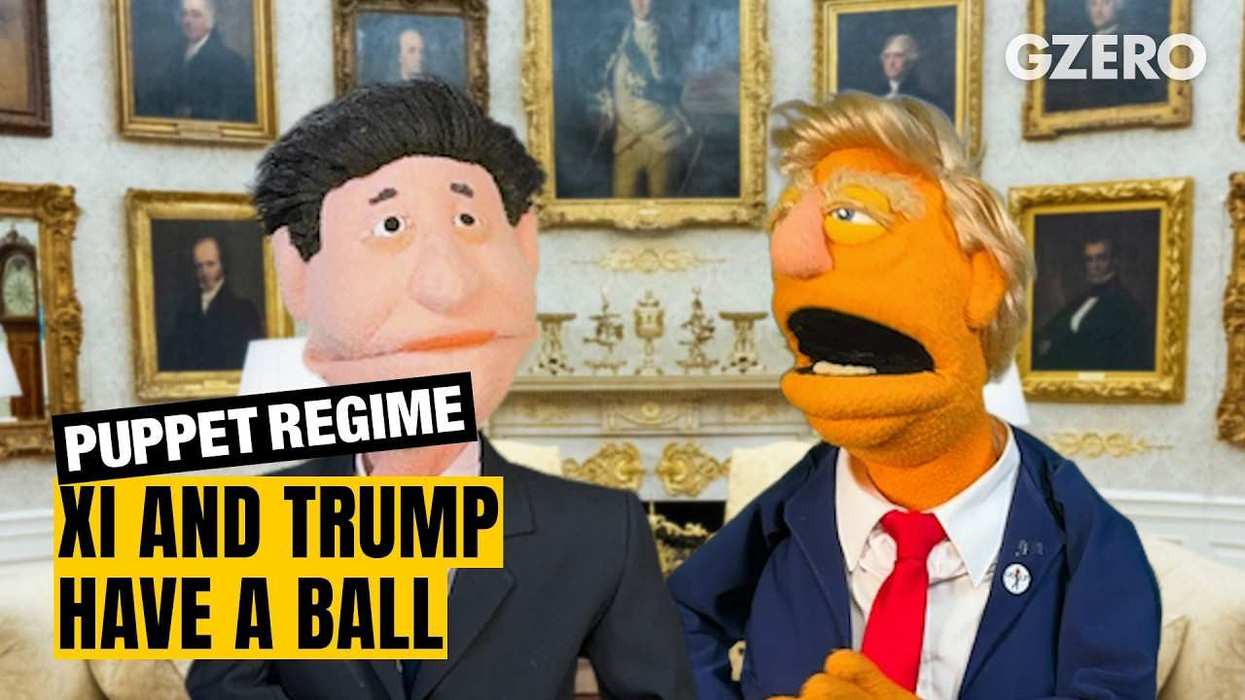
Donald Trump wants to take back the Panama Canal, and Bad Bunny’s new album "DeBÍ TiRAR MáS FOToS" is the most streamed record in the world right now. What do these two things have to do with each other?
More than you’d think. That’s because reggaetón, the genre Bad Bunny is best known for, actually has its origins on the the banks of the Panama Canal, and American foreign policy played a key role in that story.
How so? When the Americans built the canal in the years before World War I, they brought in thousands of workers from across the West Indies, but especially Jamaica, to do the hard labor. Afterward, they were permitted to live and work in the Canal Zone, a strip of US sovereign territory inside Panama that flanked the canal, ensuring US control over the waterway.
The Panamanians didn’t love this arrangement. Many felt the original canal treaties were illegitimate, and resentment at the US presence grew. In 1964, when the US stopped students from flying a Panamanian flag in the Canal Zone, a mass riot left four American soldiers and 22 Panamanian police officers dead. The Soviet Union blasted Washington’s “colonizing policy.” Fidel Castro decried “Yankee imperialism.”
In 1977, US President Jimmy Carter decided to give the canal to Panama. Carter thought this would improve America’s relations with Latin America, and avoid a more costly crisis around the Canal itself.
“Fairness, not force, should lie at the heart of our dealings with the rest of the world,” he said at the time.
Carter’s plan was unpopular at home. The stiffest opposition came from a telegenic young California governor named Ronald Reagan. But Carter’s dogged lobbying – and some help from John Wayne, whose first wife was Panamanian – helped to win narrow passage of the handover treaties. The canal itself wouldn't be given to Panama until 1999, but the controversial canal zone was dissolved almost immediately, in 1979.
And that’s where the music comes back into the story. Many of the Jamaicans and West Indians living in the Canal Zone moved to nearby Panama City. And when they did, they brought with them the popular new sound coming out of Jamaica at the time – “dancehall,” a rawer, streetier, more club-oriented successor to the reggae of the 1970s.
It wasn’t long before dancehall was reinterpreted in Spanish, becoming a new genre called Reggae en Español, a unique mashup made by the West Indians of the Canal Zone and Panama’s own Afro-Panamanian communities.
But we still aren’t in Puerto Rico yet! Right. We’re getting there.
In 1985, one of the pioneers of the Panamanian scene, known as El General, moved to New York. There he introduced the sound to the city’s huge Puerto Rican diaspora, who helped popularize it back on the island where, in turn, local artists brought hip-hop and Puerto Rican traditional styles into a musical mix that would soon go from the streets of Panama and Puerto Rico to the whole globe.
The first documented use of the term reggaeton dates from this period, when a young Daddy Yankee (whose song “Gasolina” would become the first global reggaeton hit in 2004) used it in a freestyle on an early 1990s mixtape. And just a few years after that, Benito Antonio Martínez Ocasio was born in Bayamón, Puerto Rico.
You now know young Benito as "Bad Bunny."
So why does Trump want the canal back anyway? He thinks it was a “mistake” to give up a canal that handles more than 5% of global trade. As Trump sees it, the US is locked in a zero-sum economic competition with China, and controlling that canal is critical, whether the Panamanians like it or not.
This is the inverse of Carter’s formulation – Trump's world is one where force is squarely at the center of America’s dealings with both friends and foes.
Trump's view echoes older ideas about America’s natural right to expand and dominate the Western Hemisphere. His America will, he says, be one that “expands our territory ... and carries our flag into new and beautiful horizons,” as he pledged in his inaugural address.
But do you know what the last major US territorial expansion in Latin America was? It was the takeover, in 1898, of Puerto Rico, as a result of the Spanish-American war. The island has been, in effect, a colony of the US ever since.
And to come full circle here, the negative impacts of that 127-year relationship – political repression, exploitative neglect, mass emigration, and creeping gentrification – are all major themes of … Bad Bunny’s new album.
If you want to learn more about this story – including the complicated issues of class, gender, and race that are part of reggaeton’s evolution – check out the podcast “LOUD,” a history narrated by Ivy Queen, one of the pioneering women of the genre.