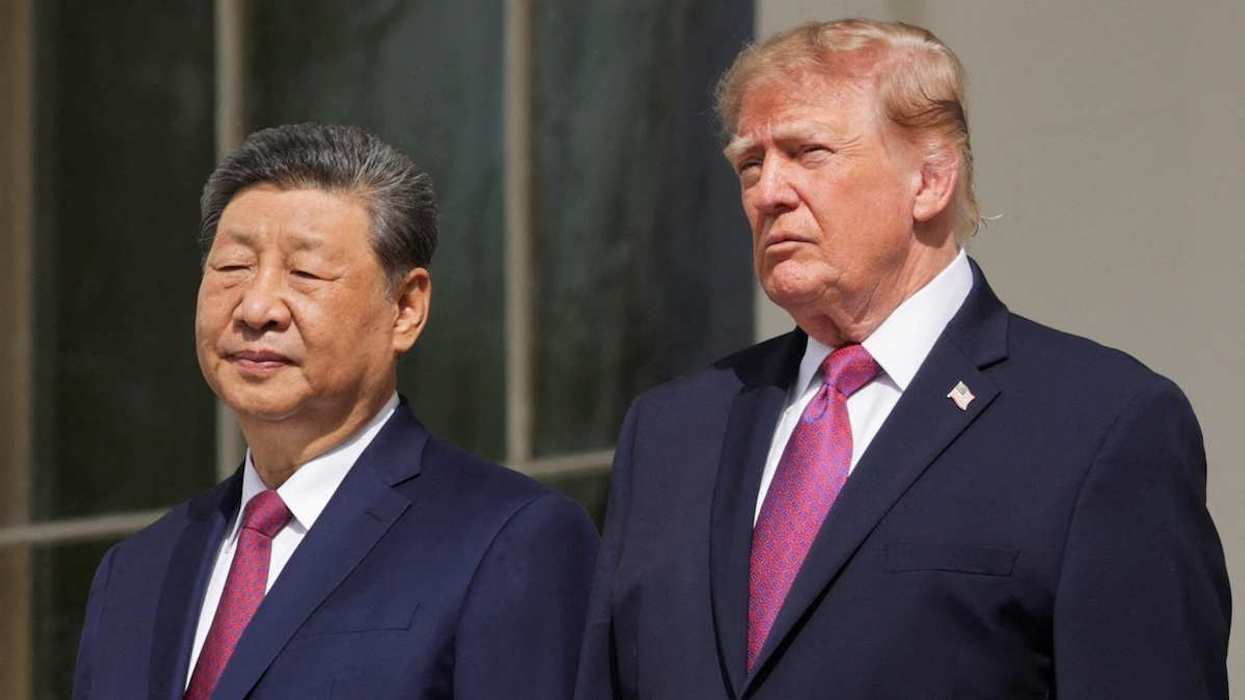
At the G20 gathering this week in Brazil, a key question emerged: Has Donald Trump already cowed world leaders, two months before he even takes power? It certainly seems like it.
The G20 leaders arrived in Rio de Janeiro to deliver their best ideas for how, collectively, to solve urgent global problems like poverty, climate change, inequality, and war.
These summits are always a little about the old ultra-verbiage, sure, but they are also meant to burnish the legitimacy and importance of multilateral approaches to global challenges.
This time, the G20 got Trumped. Loudly. The president-elect’s America First 2.0 agenda hung over the proceedings like the fearsome black cloud in Don Dellilo’s novel White Noise.
How do we measure the Trump cloud’s impact? Just look at the summit’s final communiqué, the pre-negotiated summary these gabfests always release. They merit attention not only for what they say, but also for what they don’t. This time, what it didn’t say was a lot.
Take Russia’s illegal invasion of Ukraine, for example. With Kyiv now using Western-made long-range missiles, and Putin responding by hinting at a nuclear response and flinging larger and larger missiles of his own, the communiqué’s authors played dentist, carefully extracting any teeth that might nip at the Russian leader, who of course did not attend.
“We highlight the human suffering and negative added impacts of the war with regard to global food and energy security, supply chains, macro-financial stability, inflation and growth,” it said, clearly using the secret diplomatic formula for verbal vanilla. If that alone weren’t enough for the toothless, it continued by calling for “the promotion of peaceful, friendly, and good neighborly relations among nations.”
No mention of Russia by name.
No mention of the illegal invasion.
No reminder that Putin continues to slaughter civilians and wreck critical infrastructure.
Nothing about human rights abuses.
This alone was a triumph for Putin as he eagerly awaits the return of Trump, who ran in part on questioning support for Ukraine and pledging to end the war in “24 hours.”
No one saw this more clearly than Ukrainian President Volodymyr Zelensky.
“G20 countries are sitting in Brazil. Did they say something?” he asked. “Nothing.”
The impotence of the G20s Ukraine statement was probably best summed up by a man who is himself hanging by a thread politically these days: German Chancellor Olaf Sholz, who muttered, “It is too little when the G20 cannot find the words to make it clear Russia is responsible.”
Too little.
That might be the epitaph of this pre-Trump G20.
Knowing that Donald Trump will not continue support for Ukraine, and highlighting the truth that the Global South has never supported the US and EU’s hardline views of the Russian invasion, the G20 slinked away from calling out Moscow, just as they did last year. This signals that a Trump-brokered ceasefire, which will likely give Russia much of what it wants in terms of Ukrainian territory and neutrality, looks much more likely.
But Ukraine was just the start of the smallness.
The language on the Israel-Gaza war was a boilerplate call for a two-state solution and more humanitarian aid, without a mention either of the Hamas-held hostages, the Oct. 7 attack, or the 40,000 dead in Gaza. The statement on a global billionaire tax — a decades-old idea that was particularly dear to summit host and Brazilian President Luiz Inácio Lula da Silva — was equally eye-glazing: “We will seek to engage cooperatively to ensure that ultra-high-net-worth individuals are effectively taxed.” OK … and then what?
Perhaps the only real positive was the launch of the Alliance Against Hunger and Poverty, in order to deal with the stunning fact that over 733 million people face food shortages every year. That could mean microfinance, food programs, and investment in sustainable food production. It is a good thing to see countries sign on to this even if the failure to eradicate hunger and poverty is, sadly, perennial.
Watching the leaders try to spin the summit’s accomplishments was like watching Rafael Nadal retire from tennis: a once-powerful champion reduced to swatting at balls he can’t reach, limping off the court to applause not for what he just did, but for what he no longer can do.
Like Nadal, these leaders know they are ceding the world to a new champion for the next four years, and they still have no idea what to do about it, except duck, stall, evade, and suck up.
Was there any pushback from these multilateral champions against a world shifting toward strongman isolationism, tariffs, and an American president who will begin the great retreat from the global stage of cooperation?
Not much.
The next G20 will be very different from this one, where leaders gazed up to see Rio’s famous Christ the Redeemer statue overlooking their meeting.
At the next one, they might need to find the Patron Saint of Lost Causes.