Skip to content
Search

Latest Stories

banner

Next Giant Leap is a podcast series exploring how the competition for success in space drives innovation, business, science, and economic growth here on Earth.

Next Giant Leap | The satellite revolution in Low Earth Orbit | GZERO in partnership with MDA Space | image of the Moon in space

The satellite revolution in Low Earth Orbit

Listen: In the last twenty-five years, the number of active satellites orbiting the Earth has increased from about 500 to 8,000. The latest episode of the Next Giant Leap podcast explores the exponential increase in satellites which are being launched into Low Earth orbit (LEO). This is the zone of space between about 100 and 1200 miles above the Earth.

Transcript

Listen: In the last twenty-five years, the number of active satellites orbiting the Earth has increased from about 500 to 8,000. “In the first quarter of this year, we deployed nearly 1,000”, says space industry analyst Carissa Bryce Christensen. She adds, “Instead of a smaller number of very large satellites mostly far away, we are seeing many, many small satellites very close in.”

The latest episode of Next Giant Leap, a podcast produced in partnership between GZERO and the Canadian space company MDA, explores the exponential increase in satellites that are being launched into Low Earth orbit (LEO). This is the zone of space between about 100 and 1200 miles above the Earth.


By the end of the decade, MDA’s Chief Executive Officer Mike Greenley predicts there will be tens of thousands of LEO satellites. Many of them will be the component parts of vast satellite constellations, such as the Starlink network, offering broadband internet. Others will be providing the services which the modern world has come to depend upon: GPS navigation, defense and security reconnaissance, weather forecasting, and remote environmental monitoring. For example, Earth Observation satellites are now the most important source of information on the pace and impacts of climate change.

Our satellite eyes in low Earth orbit have become extremely sensitive, according to Professor Martin Sweeting, founder of the UK company Surrey Satellite Technology Ltd. Some of them are now able to resolve objects less than one foot in size from hundreds of miles above. Artificial intelligence is now being harnessed to process and interpret the vast amounts of data gathered by the new generation of satellites.


Carissa Bryce Christensen

Carissa Bryce Christensen. Credit: BryceTech

Carissa Bryce Christensen

Founder and Chief Executive Officer, BryceTech

Carissa Bryce Christensen is the Chief Executive Officer and founder of BryceTech companies in the US and the UK. She previously co-founded defense company The Tauri Group and quantum computing software company QxBranch. Ms. Christensen is an internationally recognized expert on the satellite and space industry, known for rigorous analysis and innovative, data-driven strategy. She co-chairs the World Economic Forum Global Future Council on Space, and chairs the US board of the UN-affiliated Space Generation Advisory Council.

Mike Greenley

Mike Greenley. Credit: MDA

Mike Greenley

Chief Executive Officer, MDA

Mike Greenley has been the Chief Executive Officer of MDA since 2018. Founded in 1969, MDA is an international space mission partner and a robotics, satellite systems and geointelligence pioneer. Mr. Greenley oversees more than 2,700 employees across Canada, the United States and the United Kingdom. Mr. Greenley has over 25 years of experience in the defence and security business. Mr. Greenley is the Vice-Chair of Space Canada and recently served as the Vice-Chair of the Government of Canada’s Economic Strategy Table for Advanced Manufacturing.
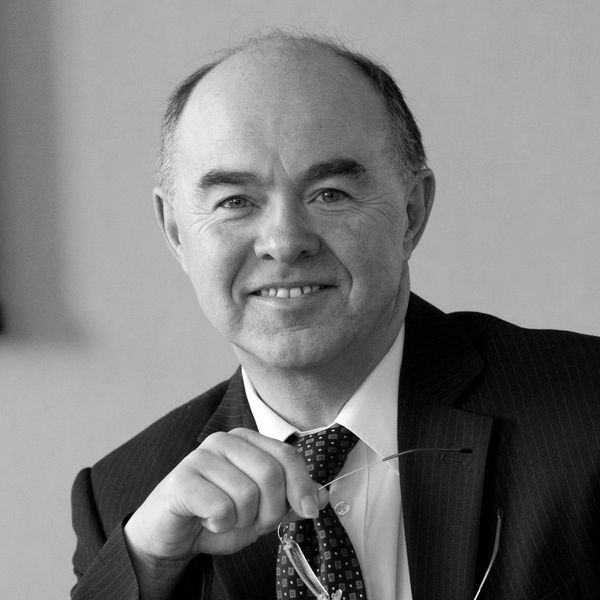
Professor Sir Martin Sweeting

Professor Sir Martin Sweeting

Professor Sir Martin Sweeting

Founder and Executive Chairman, Surrey Satellite Technology Ltd

Professor Sir Martin Sweeting pioneered rapid-response, low-cost and highly capable small satellites, utilizing modern consumer electronics devices to change the economics of space. He is widely regarded internationally as the ‘father’ of small satellites which have changed the nature of the space industry. He is distinguished professor of space engineering at the UK’s University of Surrey. In 1985, he founded the university spin-off company, Surrey Satellite Technology Ltd which has designed, built, launched and operated in orbit nano, micro and mini-satellites for communications & Earth observation, as well as navigation payloads for the European Galileo constellation. Sir Martin is Fellow of the UK Royal Society and the Royal Academy of Engineering.

Kevin Fong

Kevin Fong. Credit: Anthony Cullen

Dr. Kevin Fong (host)

Professor, Department of Science, Technology, Education and Public Policy (STEaPP) at University College London

Kevin Fong is a senior emergency care physician and anesthesiologist in the UK’s National Health Service. He is also an expert in space medicine and has worked as a researcher in NASA’s human spaceflight program in Houston. He is also a broadcaster who has hosted many radio and television shows, and podcasts on space flight and exploration. They include the BBC hit podcast ‘13 Minutes to the Moon’.

Next Page

More from Next Giant Leap

Could the future of industry lie among the stars?

Listen: Creating artificial human retinas in zero gravity. Mining rare minerals on the moon. There seems to be no limit to what could be possible if we continue to take our more important industries to space. Join Mike Massimino and Mike Greenley on this episode of Next Giant Leap as they explore the industrialization of space. Dr. Joan Saary sheds light on the potential of designing medical treatments in microgravity and treating astronauts in orbit, and Dr. Gordon Osinski explains the exciting future of resource extraction on other planetary objects.

Keep reading... Show less

Listen: Creating artificial human retinas in zero gravity. Mining rare minerals on the moon. There seems to be no limit to what could be possible if [...]

More >

The two trillion dollar opportunity

Listen: You might not know it, but you interact with space technology countless times on a daily basis. In fact, the space economy has become so ubiquitous that some estimate that its value could reach as high as $1.8 trillion by 2035. On this episode of Next Giant Leap, hosts Mike Massimino and Mike Greenley are joined by Alex MacDonald, former Chief Economist at NASA. They discuss the surprising history of private investment in the space industry, the many reasons for the current boom, and how you might get a job in the space world.

Keep reading... Show less

Listen: You might not know it, but you interact with space technology countless times on a daily basis. In fact, the space economy has become so [...]

More >

A new era of space defense

Listen: For many of us, the idea of a space-based arm of the military calls to mind images from science fiction. But the real-life world of space defense has become increasingly integral to military operations on land, at sea, and in the air. In this episode of Next Giant Leap, hosts Mike Massimino and Mike Greenley explore the world of space military technology. Guests Major General (Ret.) Kim Crider formerly of the United States Space Force, and Brigadier-General Chris Horner of the Canadian Space Division walk us through the many innovations in this fascinating arena, and attempt to answer one crucial question: how do you secure a domain with no borders?

Keep reading... Show less

Listen: For many of us, the idea of a space-based arm of the military calls to mind images from science fiction. But the real-life world of space [...]

More >

The new Sputnik moment

Listen: Over the last decade, the world of space exploration and innovation has exploded. On this episode of Next Giant Leap, season 2 hosts Mike Greenley, CEO of MDA Space, and Mike Massimino, Columbia Engineering professor and former NASA astronaut, take a look at the new space race with former Congresswoman Jane Harman and China expert Dean Cheng. They discuss the role of space in national security, the potential for space-based conflict, and the role of private space companies in this new era.

Keep reading... Show less

Listen: Over the last decade, the world of space exploration and innovation has exploded. On this episode of Next Giant Leap, season 2 hosts Mike [...]

More >

GZERO Podcasts

At a moment when Americans can’t agree on much of anything, one unlikely institution still commands broad trust: Wikipedia. On the GZERO World [...]

More >

Listen: What does global energy transition look like in a time of major geopolitical change, including rebalancing of trade? In this special episode [...]

More >

Listen: Creating artificial human retinas in zero gravity. Mining rare minerals on the moon. There seems to be no limit to what could be possible if [...]

More >

At a moment when Americans can’t agree on much of anything, one unlikely institution still commands broad trust: Wikipedia. On the GZERO World [...]

More >

Transcript Listen: “The equivalent of what we spent in World War II was spent in the course of a year and a half to support the US economy, and that [...]

More >

Listen: Investing in health and science research isn’t just about curing diseases. It has huge impacts across society, from creating jobs to driving [...]

More >

Listen: As populations grow and communities evolve, transportation authorities and urban infrastructure are seeking ways to modernize.In this episode [...]

More >