VIDEOSGZERO World with Ian BremmerQuick TakePUPPET REGIMEIan ExplainsGZERO ReportsAsk IanGlobal Stage
Site Navigation
Search
Human content,
AI powered search.
Latest Stories
Start your day right!
Get latest updates and insights delivered to your inbox.
Quick Take
Ian Bremmer, political scientist and president of Eurasia Group and GZERO Media, shares insights on global political events.
Presented by

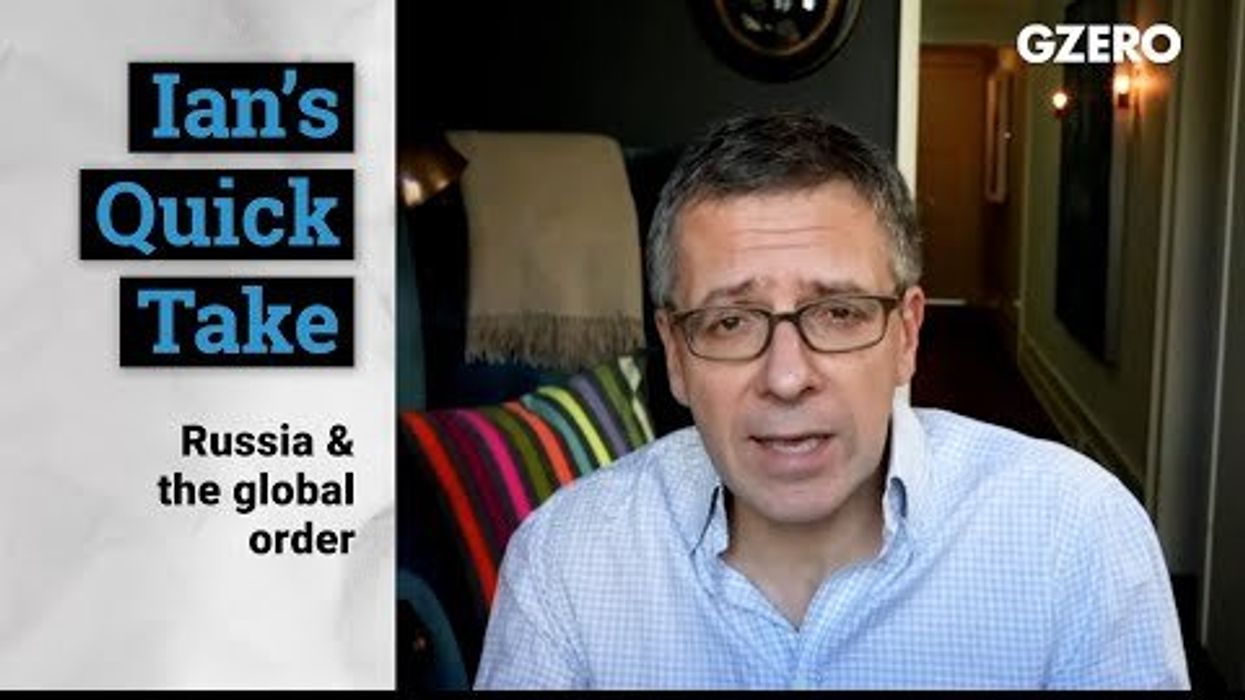
Ian Bremmer's Quick Take: Lots of Russia news, as is so often the case over the last year. A little bit less frankly about Ukraine and more about Russia's position vis-a-vis the US and the global order, and I fear/suspect that that is increasingly going to be what we're going to be talking about going forward. One big piece of news, of course, this American journalist for the Wall Street Journal arrested on charges of espionage, Evan Gershkovich, it's going to be a secret trial. The Russians, having picked him up, said that they caught him red-handed. There is no presumption of innocence when you're grabbed on espionage in Russia.
The Americans will probably never find out what they're even specifically charging him with. And this is 20 years, up to 20 year sentencing, almost certain over the coming couple of months that he will be found guilty and then probably sent to a high security facility, could be tortured. I mean, this is the sort of thing that we've been seeing from Alexei Navalny over the past year, and is a clear step up in a direct action against American citizens by Russia. We haven't seen anything like this, frankly, since the '80s. So I mean since the heyday of the Cold War, '86 I think was when Daniloff was arrested. So in other words, before Perestroika, before Glasnost. This were the real old days of, as Ronald Reagan called them, Evil Empire. Well, that's clearly where US-Russia relations are right now. And unlike previous arrests, this meant to cause massive headlines and meant to be arbitrary, meant to chill the idea that Western journalists can conduct their business in Russia. They should obviously all leave. And also meant to show the Americans that the Russians are willing to take more direct, albeit incremental, steps beyond outside the Ukraine War directly.
If you go to Russia, if you listen or watch their state media, you'll see that they have been saying that they're fighting a war, not against Ukraine, but against NATO. And that's because NATO is providing the training, they're providing the equipment, they're providing the material, they're providing the intelligence. They're not involved in the fight directly, but they're certainly indirectly engaged in a proxy war after the Russians illegally invaded Ukraine. The Russian response to this is increasingly being willing to lash out against Westerners. And I think this is an important and significant escalatory move, even if it's one that has been calculated by the Russians not to lead to a precipitous American reaction, not the kind of thing that we want to see.
And then on top of that, this weekend, another terrorist attack, this in St. Petersburg, and where a cafe that had been owned by Yevgeny Prigozhin, who is the CEO, Owner of the Wagner Group, this paramilitary organization that has been doing a lot of fighting at Putin's behest, of course in Ukraine. And in early fighting, reasonably successfully, more recently not so much, in part because they've not been able to get ammunition, and they've been increasingly public about that and increasingly directly critical of the Russian Defense Ministry, of Russia's regular military forces and hierarchy and leadership, not of course directly in any way critical of Putin himself. But that fight has been growing, and so the fact that Vladlen Tatarsky, who is a very well-known military blogger, is incredibly hawkish, is hugely supportive of the war in Ukraine and has been supported by Prigozhin and the Wagner Group, he was assassinated, bomb went off, apparently hidden in a statuette that was presented to him by some woman who attended the talk.
Of course, immediately we're going to hear that this was the Ukrainians behind it. The Ukrainians, of course, were found to be behind the assassination attempt of Aleksandr Dugin, who is a strong sort of ultra nationalist, calling essentially for genocide of Ukrainians. And didn't get him, got his daughter instead, when at the last moment they switched cars. That's a terrorist attack, he's a civilian. But certainly wasn't intended to have collateral damage. Here you saw the video perhaps, I mean, it blew up the cafe and lots of other people were injured. It could have been the Ukrainians. I'm not saying it's implausible, but in this case, I think it's unlikely. I think it's more likely that this is a group that is not happy with Prigozhin increasingly attacking them. So perhaps either anti-war movement in Russia, or perhaps more likely pro-war movement in Ukraine, which is the vast majority of the Russian people at this point, but anti-Prigozhin, anti-Wagner group.
And the fact that there is this internal fight in Ukraine, ultimately that that's not likely to go well. And they haven't been able to take the town of Bakhmut after months of fighting, after lots of crowing by Prigozhin that this was imminent, and even Zelensky was able to visit in the past couple of weeks. Clearly an enormous embarrassment for Prigozhin, and this implies that he's under a lot of pressure. And frankly, I mean, there have been some rumors that he could be the next president of Russia challenging Putin. I think it's much more likely that he isn't with us for very much longer, that someone takes him out. But in either case, what we're seeing is more instability in Russia, more pressure on Russia.
The Russian economy performed extremely well compared to the sanctions that were leveled against it in the first year of the war. Indeed, the Americans have been surprised with how resilient the economy was. In the early days of the war, the US focused much more on economic sanctions and less on the provision of direct military support to the Ukrainians. Turned out the latter was much more important than the former in making a difference in the battlefield. And that was probably an early mistake by the Biden administration. But now that we're in the second year, we are seeing that Russian gas is getting stranded, Russia's having a harder time exporting oil, also at a significant discount, and the pressure on the Russian economy is growing. They've also lost an enormous amount of human capital, and of course the cost of the war itself. And they have to rebuild their own military industrial complex, which means they lose a lot of the contracts for export, which were a big source of hard currency for the Russians.
And we saw Oleg Deripaska, the oligarch, recently saying publicly that he sees the Russian economy under a lot more pressure. He wasn't saying that three months ago, six months ago. So all of those things imply that while the war in Ukraine is becoming somewhat more stable, not as many frontline attacks, frankly not as many civilians getting killed, and not as much movement territorially either in favor of the Ukrainians or the Russians. That may change with an imminent Ukrainian counter offensive, though even then, probably not all that much. But the position of Russia vis-a-vis NATO, we continue to see nothing but escalation, as we are in the 14th month of this war. And that, of course, longer term is much more dangerous geopolitically.
So that's a little bit for me. That's where I see right now. I hope everyone's going well, and I'll talk to you all real soon.
Keep reading...Show less
More from Quick Take
Zelensky, Trump, and NATO: A united front on Ukraine?
August 18, 2025
Trump and Putin to meet in Alaska to discuss Ukraine
August 11, 2025
US government rescinds West Point role for former cyber director
August 04, 2025
US-EU trade deal marks a win for Trump
July 28, 2025
The US, China, and the critical minerals question
July 21, 2025
Epstein conspiracies divide Trump's MAGA base
July 14, 2025
US-Brazil relations in crisis
July 10, 2025
Elon Musk vows to start a new political party
July 07, 2025
What Zohran Mamdani’s win really signals for US politics
June 30, 2025
Iran's retaliation shows strategic weakness
June 23, 2025
US enters war with Iran: What comes next?
June 22, 2025
Iran looks to negotiate ceasefire
June 16, 2025
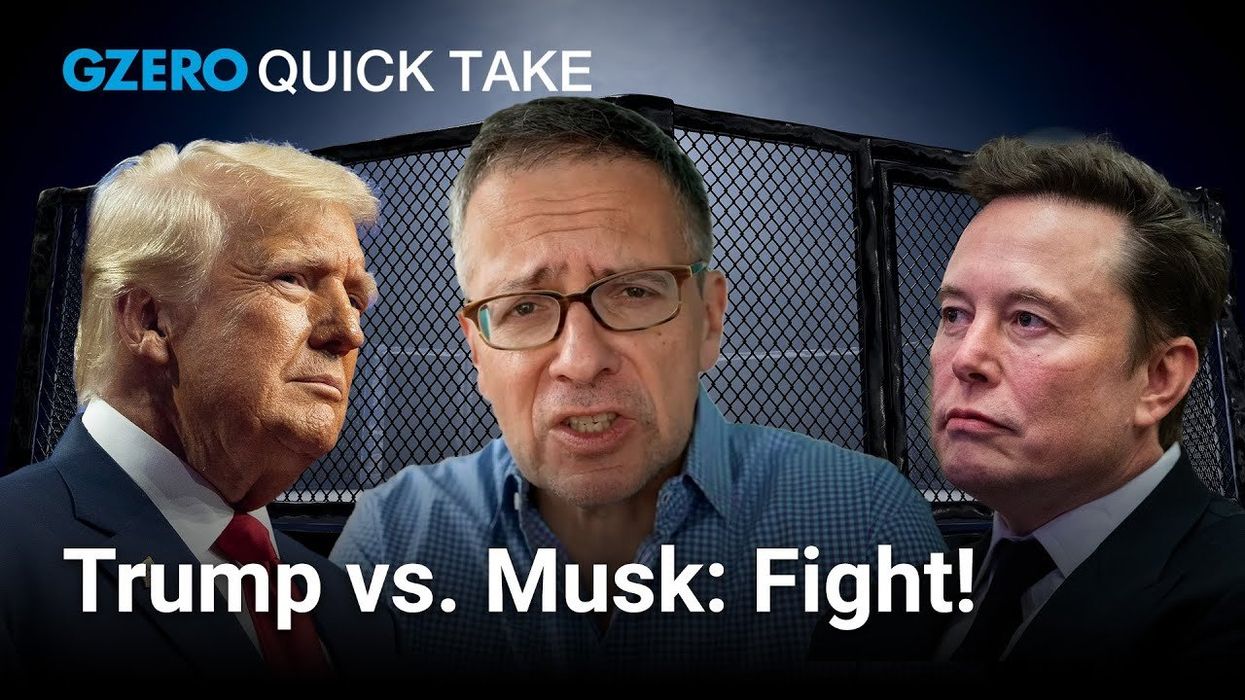
Elon vs. Trump: Billionaire fallout goes public
June 06, 2025
Elon Musk steps down from Trump administration
May 29, 2025

Trump's weekend of geopolitical success
May 12, 2025
Can Trump and Carney reset US-Canada relations?
May 07, 2025
Trump’s ‘less is more’ message is un-American
May 05, 2025
Ian Bremmer on Trump's first 100 days
April 28, 2025
Trump’s America: A kleptocracy but not a police state
April 23, 2025
Inside the Harvard-Trump showdown
April 21, 2025
Can the US win by undoing globalization?
April 14, 2025
Who benefits from Trump's tariff wall?
April 07, 2025
Trump's tariffs & the end of globalization
April 03, 2025
Leaked Signal chat shows Trump team's mindset
March 26, 2025
What Trump team's war plans leak revealed
March 25, 2025
Is Europe in trouble as the US pulls away?
March 24, 2025
Putin-Trump Ukraine call is a small win for both sides
March 18, 2025
What will Trump offer Putin in Ukraine ceasefire talks?
March 17, 2025
Ukraine ceasefire deal now awaits Putin's response
March 11, 2025
Can Europe broker a Ukraine ceasefire?
March 03, 2025
What Trump-Zelensky fallout means for Ukraine war
March 01, 2025
Why the US-Ukraine minerals deal changed
February 26, 2025
Germany's close election limits its ability to lead Europe
February 24, 2025
Ukraine hopes for Europe's help as US negotiates with Russia
February 18, 2025
JD Vance stuns Munich conference with critique on European democracy
February 14, 2025
Trump-Putin chat over Ukraine "deeply" worries Europe
February 13, 2025
What is Trump's Gaza playbook?
February 10, 2025
Why cutting USAID will hurt American foreign policy
February 05, 2025
Why is Trump starting a trade war with Canada?
February 02, 2025
How Trump's assertive foreign policy impacts international relations
January 27, 2025
Trump's Davos address sets up big shifts in US strategy
January 24, 2025
From Davos: How global leaders are grappling with Trump’s return
January 20, 2025
Ian Bremmer on the forces behind the geopolitical recession
January 17, 2025
What Greenlanders might want from a deal with Trump
January 13, 2025
New Year's Day terror attacks highlight America's divisions
January 03, 2025
GZERO Series



© 2025 GZERO Media. All Rights Reserved | A Eurasia Group company.
GZERO Daily: our free newsletter about global politics
Keep up with what’s going on around the world - and why it matters.