Site Navigation
Latest Stories
Sign up for GZERO Daily.
Global Stage LIVE from United Nations WATCH REPLAY
Quick Take
Ian Bremmer, political scientist and president of Eurasia Group and GZERO Media, shares insights on global political events.
Presented by

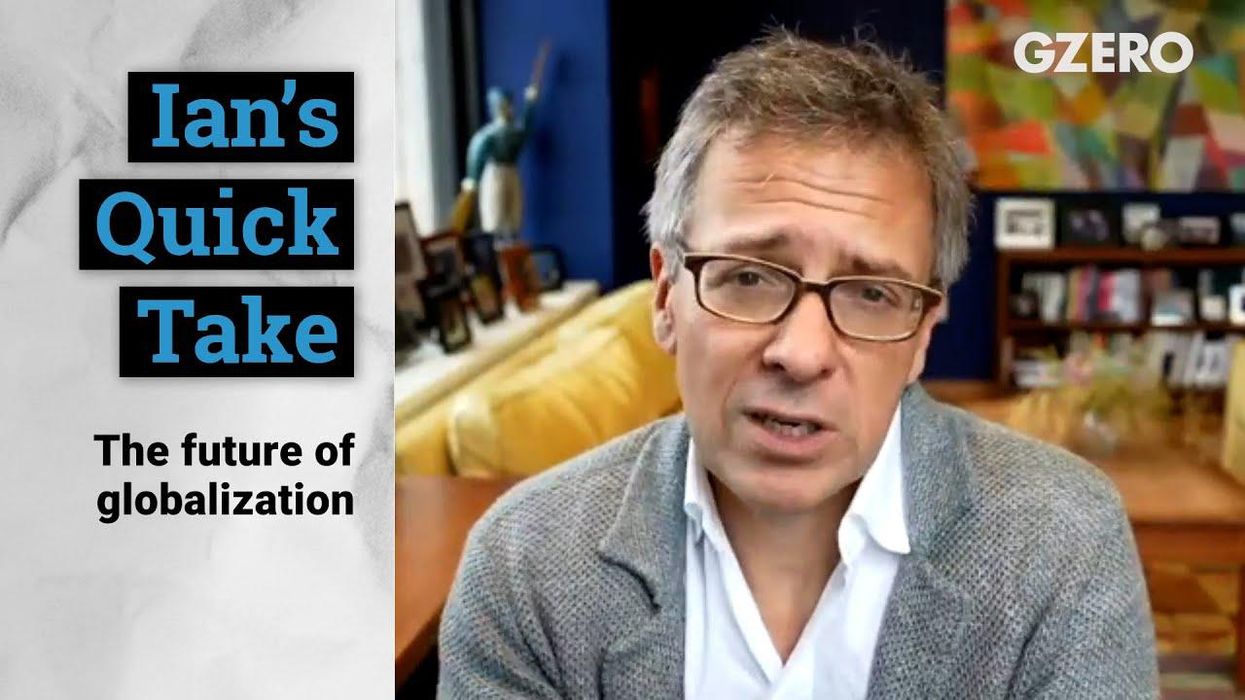
Ian Bremmer's Quick Take: Hi everybody, Ian Bremmer here, and a Quick Take to get us kicked off this Monday morning. I thought I'd go a little macro today and talk about the future of globalization, because I hear so many people talking about the last 30 years of being this unprecedented period of goods and services and people and ideas and capital moving faster and faster across borders all over the world. And now, not anymore. Now, it's all about my country first and it's nationalists and it's insourcing and it's decoupling. And so we've hit this tipping point. Or have we? I don't quite buy this narrative that globalization is over. Rather, I think it's not being driven. I think people are angry about it and it's being fought over, but that's very different from saying that spikes are being put into it.
And let me explain what I mean. I do think that the era of globalization, where the United States as a singular country with its allies was driving, actively leading, and driving a system where tariffs were being reduced and institutions were being created to ensure freer and more efficient trade. That was unique. It was something that we experienced in the world, basically from the seventies, picking up momentum through the nineties, with the Chinese particularly getting much, much bigger, with the Soviets then collapsing and most of those economies getting integrated into a more global order.
Right up through the last, say, 10 years, that let's say almost half a century if you look at global human development indicators like expansion of lifespan or reduction of infant mortality or education rates or average income levels, just an unprecedented improvement across the world. And most importantly, if you were an alien looking down on the planet, what you'd see is the emergence of a global middle class. And you'd see immense reduction in human poverty.
Now, the fact that a lot of that within the United States and other countries driving it was also accompanied with policy failures, with a lack of change of institutional reforms inside the countries, with social safety nets that were eroding meant that there was much greater levels of inequality, of outcome and of opportunity inside those countries and a lot of people got angry and angrier with globalization. At the same time, over the last few years, post the 2008 financial crisis, post the pandemic, with increasing impact globally of climate change and now with the Russia-Ukraine war, all of those things are driving much greater instability and inequality, not just in the advanced industrial economies, but in the developing world as well. And that's creating a lot more anger and pushback against the process of globalization.
Where I want to be clear is that's not suddenly making the Americans turn against globalization. Rather, it's making the Americans not sure where they want to go. It means that the United States aren't leading further globalization going forward, and no one really is. So you had 30 to 50 years where the Americans and increasingly everyone on that boat were saying, "Yes, let's push hard to have more and more open markets." And now you have governments all over the world saying, "We're not really sure what we want, where we want to go." That's very different from the idea of deglobalization.
Deglobalization would be the United States stands up and says, "We're going to tear down these institutions. We actually don't want to be as engaged in international trade. We're going to pull out of existing trade agreements." That's not what's happening. Not under Trump, not under Biden. I mean, in fact, you'd say the record is mixed. Trump pulled out of the Trans-Pacific Partnership, but that was a new multilateral trade organization the US would've joined to increase globalization, to increase integration. But actually, the overall record under Trump with the US-Mexico-Canada agreement, with the US-South Korea agreement, with a first phase US-China trade deal, but then no second deal, not full implementation, increased tariffs, on balance, you'd say under four years of Trump, the US globalized a little bit more, but not much more, and certainly wasn't driving or leading globalization anymore.
And you'd say the same thing under Biden. You could point to the Indo-Pacific Economic Framework, which has marginal increase in economic integration on rules and standards. For example, you can talk about "Build Back Better", which isn't really funded, but provides more outreach of the United States towards international investment together with allies around the world, some reduction in tariffs between the United States and Europe. Not yet between the United States and China, though it's fairly likely. Again, the US isn't leading globalization anymore, but it's not unwinding globalization either. And "Make America Great Again", as well as a new foreign policy for the American foreign middle class, which is sort of the Trump headline and the Biden headline. If you say, "Well, what are the takeaways?" The takeaways are not a lot of policy that's actually really moving towards insourcing production. A little bit of a shift away from the promotion of more globalization, and on balance, a little more globalized than before now.
The big hit, of course, in the last two years has been the pandemic, which stopped people from traveling, and which really shut down a lot of international supply chain for a period of time that largely has gone away in most of the world. China's the big exception because of zero-COVID, but even there, they're working hard to try to get through zero-COVID relatively quickly. And I expect they will be mostly there by the end of 2023, because it's such a drag on Chinese growth, but it's a blip. It's a blip from a longer term environment where what we see between the United States, China and the Europeans and the Japanese and the developing world is kind of a bit of a drift.
In the same way that NATO has been adrift over the last 20 years without much of a mission, now we're seeing globalization is drifting. It's not falling apart, but no one's driving the bus. And there is some decoupling that's going on, most notably between the G7 and Russia. So Russian's being forcibly cut off from the advanced industrial economies. And of course, some of that is sticky, like gas between Russia and Europe. And that diversification is taking time and the Russians are threatening to shut it down.
Then you have some decoupling happening at the national security level between the United States and China, but it's limited. It doesn't affect most US-Chinese trade. TikTok. It's what all the young kids are on. That's Chinese, by the way, right? No one's about to shut that down. And other countries around the world don't want a cold war between the US and China, and they're ramping up their investment in exposure to the US and to China. And then you also have some level of growing protectionism in countries around the world saying, "We want more support for our workers," but it's halting, it's stagger step. And it's also in fights inside these countries with business interests and financial interests that want more exposure to global markets.
So the point here is not the end of globalization. The point is that globalization is at drift. The point is that globalization is now being fought over. It's become a political football. And where that's going to go? The answer is, it's messy. It's complicated. Maybe that's not the easy headline answer that people want, but maybe that's why my Quick Takes take 10 minutes as opposed to two.
Anyway, that's it for me at the start of this week. Something to chew over for a few days. Hope everyone's doing well. I'll talk to y'all real soon.
For more of Ian Bremmer's weekly analyses, subscribe to his GZERO World newsletter at ianbremmer.bulletin.comMore from Quick Take
GZERO Series
GZERO World with Ian Bremmer

Puppet Regime
Quick Take

ask ian
Ian Explains
GZERO Reports
GZERO Europe
The Debrief

GZERO Daily: our free newsletter about global politics
Keep up with what’s going on around the world - and why it matters.