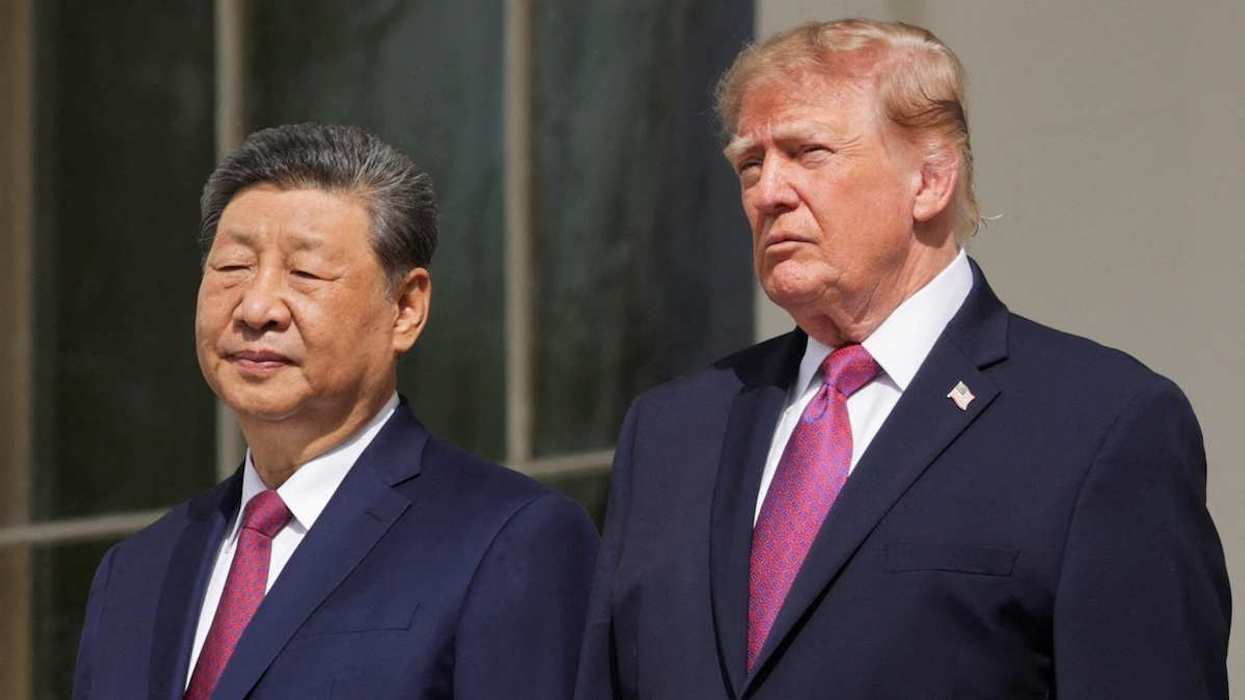
Russian and Chinese leaders got together this week in Beijing at a time when Russian troops were threatening Ukraine, renewing speculation about the risks the two powers pose for the “liberal world order.” In US media, Vladimir Putin and Xi Jinping are often treated as twin Bond villains ready to give 007 a super-sized headache, but looked at from their point of view, their partnership makes a lot of sense.
Their relationship is often dismissed as “transactional,” particularly since China’s decades-old embrace of capitalism and the 1991 Soviet collapse leave them with no common Marxist ideology. But their transactions are important for both countries.
Thanks to Western sanctions, Russia is now more trade dependent on China. In particular, China “is a growing importer of Russian oil, gas, and LNG,” says Eurasia Group analyst Alex Brideau. In turn, China counts on Russia to support its foreign policy goals and provide energy supplies through overland pipelines that are “not vulnerable to interdiction by the United States or its allies,” says Neil Thomas, a China expert with Eurasia Group.
Any Chinese decision to sharply increase purchases from Russia will take time and plenty of investment in new infrastructure, but that’s an increasingly attractive prospect in a world where US financial pressure and European fear of a too-deep dependence on Russia and China leave both sides seeking future commercial opportunities elsewhere.
More broadly, China and Russia say they intend to work together to advance a “trend toward redistribution of power in the world.” Both are sick of American lectures on democracy and human rights, and neither wants to be told how they should treat their own citizens or their neighbors.
That power shift is no pipe dream. Yes, only America can project traditional military power into every region of the world. But in today’s world, “power” depends more on economic clout, access to valuable commodities, and the sophistication of cyber-weapons than on aircraft carriers. In that sense, the size of China’s economy, Russia’s natural resource wealth, and the capabilities that both countries have demonstrated in cyberspace remind us that the Cold War ended three decades ago.
China and Russia also know that US allies, the source of another of America’s great strengths, understand the shifting balance of power too. Europe, Japan, and other traditional American friends may share many values with the US, but they need decent relations with China and Russia for trade opportunities and energy security respectively.
China and Russia can also make arguments about America’s relationship with democracy that aren’t easily dismissed. How can Americans lecture the world on the value of democracy, they ask, when one-third of Americans refuse to accept that Joe Biden is the legitimate president of the United States? If Washington cares so much about democracy and human rights, why is Egypt considered a “major non-NATO US ally?” Why does the US treat the Kingdom of Saudi Arabia as a vital partner?
And by what right does Washington define democracy for the world? Most Americans consider Russian elections and China’s claims of being a democracy farcical, but plenty of countries resent US demands for fundamental reforms to their political and economic systems.
The emerging Chinese-Russian partnership will always remain limited. The defining feature of their relationship is the reality that Russia is very much the junior partner. China has the world’s second-largest economy. Russia’s GDP, meanwhile, is smaller than Canada’s and half the size of California’s.
In addition, China’s larger economy makes it far more dependent on the health of its trade with the United States than Russia will ever be. In that sense, China is still mainly a status quo power that treats war as bad for business, while Putin likes to throw opponents off balance (see Russian troops at Ukraine’s border). China and Russia are also natural competitors for influence in Central Asia, the Arctic, and elsewhere.
But China and Russia share a common aspiration (a bigger share of global power) and a common obstacle (Washington). Today, we’re talking about the potential for China and Russia to make common cause over NATO’s role in Eastern Europe. Tomorrow, it might be Russian support for China’s approach to Taiwan.