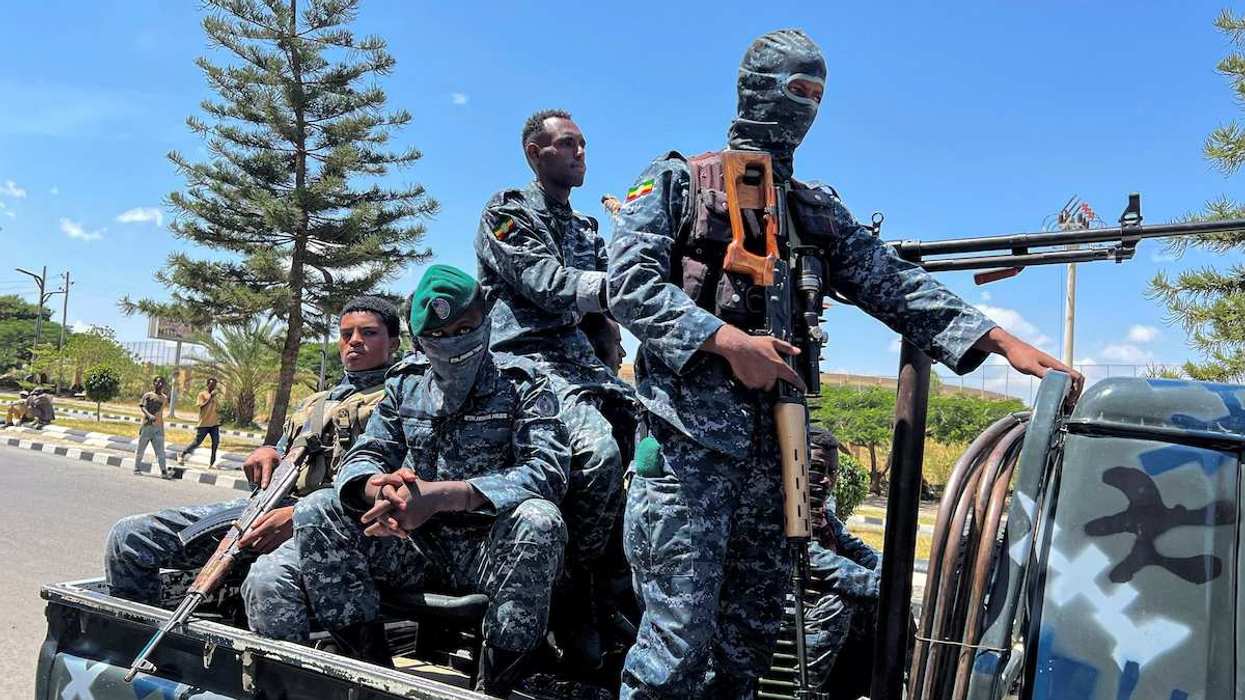
The fight for the Nile: In recent days, the Trump administration has tried to mediate three-way talks between Egypt, Sudan, and Ethiopia on their long-running dispute to access the waters of the Nile. In short, a 1929 treaty gave Egypt and Sudan rights to nearly all Nile waters and the right to veto any attempt by upstream countries to claim a greater share. But in 2011, Ethiopia began work on the so-called Grand Renaissance Dam on the Blue Nile tributary from where 85 percent of the Nile's waters flow. The project, due for completion next year, will be Africa's largest hydroelectric power plant. Egypt, which draws 85 percent of its water from the Nile, has made threats that raised fears of military action. We're watching as this conflict finally comes to a head early next year.
China's Plague: Doctors in Beijing have diagnosed two people with pneumonic plague, a highly-contagious disease more deadly than the bubonic version—one that can prove fatal within three days. According to the World Health Organization (WHO), the lung-based pneumonic plague is very contagious and "can trigger severe epidemics through person-to-person contact via droplets in the air." Both patients come from sparsely populated province of Inner Mongolia, but are now being treated in a city of more than 20 million. Outbreaks of disease inside China raise special concerns because Chinese state secrecy undermine international confidence that published information is accurate. In this case, the WHO has confirmed that Chinese authorities have notified them about these cases. How China's government might handle information that the disease has spread is another question.
War crimes by Turkish-backed forces? US officials have surveillance footage that appears to show Turkish-Supported Opposition forces (TSO) targeting civilians in northeastern Syria. The (unverified) imagery appears to show extra-judicial executions of Syrian Kurds. State Department officials say they're also investigating a report of chemical weapons used against Syrian Kurds. US Secretary of Defense Mark Esper has called Turkey's reported violations "horrible," and said, "if accurate – and I assume they are accurate – they would be war crimes." It was against this backdrop that President Trump welcomed Turkey's President Recep Erdogan to the White House on Wednesday and pronounced himself a "big fan of the president."
Australian universities' China crackdown: The Australian government unveiled new cybersecurity guidelines on Thursday to address growing concerns over Chinese infiltration at Australian universities. The voluntary guidelines – which set out steps to enhance cybersecurity and improve due diligence in research collaboration – are safeguards against what the government has called "unprecedented" levels of foreign interference in the sector. In September, the University of Technology Sydney found itself in hot water after collaborating with a Chinese company with ties to mass surveillance technology used to track the persecuted Uighur minority. Beijing hackers are accused of stealing a trove of personal data from the prestigious Australian National University. Australia's responses come at a cost: Anti-foreign interference laws passed by Canberra last year exacerbated tensions with Beijing at a time when Chinese students contribute about $12 billion a year to the Australian economy.
The future of democracy: Steven Levitsky and Daniel Ziblatt, authors of the 2018 book How Democracies Die, have a compelling new article in the most recent issue of The Berlin Journal. In it, they warn that the greatest threats to democracy today "begin at the ballot box." The examples, they say, are many. "Like [Hugo] Chávez in Venezuela, elected leaders have subverted democratic institutions in Georgia, Hungary, Nicaragua, Peru, the Philippines, Poland, Russia, Sri Lanka, Turkey, and Ukraine...The tragic paradox of the electoral route to authoritarianism is that democracy's assassins use the very institutions of democracy—gradually, subtly, and even legally—to kill it."
What We're Ignoring:
Aeroflot Rules: Mikhail Galin's cat Viktor is a little overweight, but there's no reason Viktor shouldn't be allowed to travel safely between Moscow and Vladivostok. Russian airline Aeroflot has a rule that pets weighing more than 8 kilos (17 lbs) can only travel aboard its flights in the cargo hold rather than in the cabin. Click here to read about Mr. Galin's elaborate plot to get Viktor safely aboard the flight. (It involves a skinny decoy cat.) But Aeroflot has discovered Galin's scheme and stripped him of his frequent flier miles. We hereby call on all GZERO readers to devise clever new ways to smuggle fat cats onto Aeroflot flights. #FightThePower