June 06, 2024
Tucker Carlson has called for an invasion of Canada to liberate America’s northern neighbors from Prime Minister Justin Trudeau, but it turns out that Canadians are liberating themselves and invading the US in droves.
Well, they aren’t invading, but they are emigrating at a rate not seen in years.
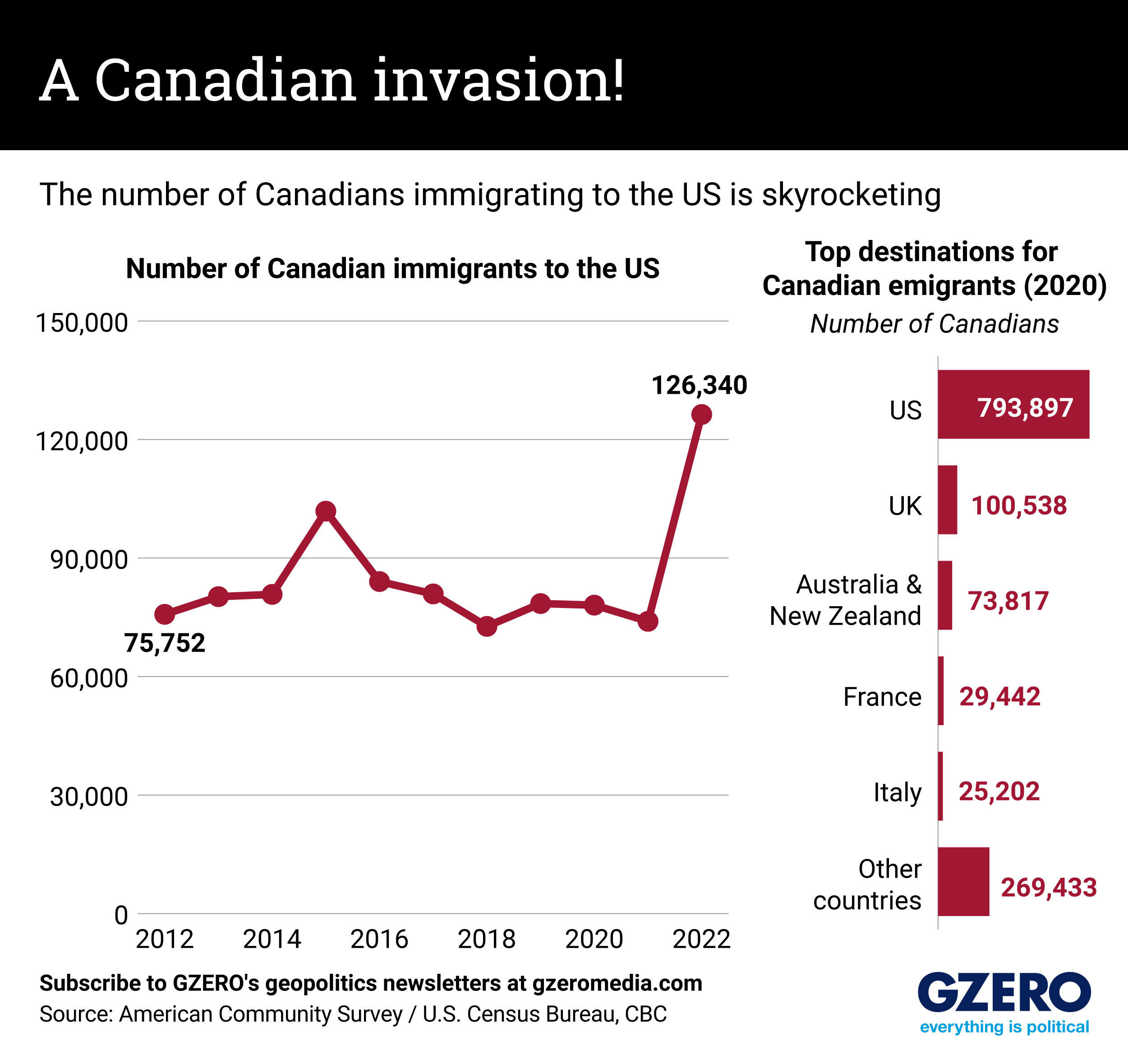
According to the US Census Bureau, the number of people moving from Canada to the US hit 126,340 in 2022. That's an increase of nearly70% over the 75,752 people who made the move in 2012.
Tens of thousands of Canadians are moving south of the 49th parallel because of sky-high housing costs. The benchmark home price in Canada has more than doubled over the past decade to $755,000 and has become increasingly detached from earnings. Across 10 large cities, mortgage payments eat up about 59% of household earnings, according to the National Bank of Canada. Meanwhile, in the US, the average house costs $424,552.
A significant portion of others report moving for love, work, warmer weather, or lower taxes in states like Florida and Arizona. Wages are often a lot higher in the US, especially for in-demand professions like information technology and health care.
Canadians’ biggest complaint upon arrival? The politics. Followed by the dearth of public healthcare.
More For You
US-Canada talks hit tariff deadline, Meta goes on trial, Japan to test missiles in Australia
Aug 18, 2026
A banner reading "Buy Canadian", in response to U.S. President Donald Trump's 25% tariffs on goods from Canada, is held aloft by a pair of hockey sticks in front of a house in Winnipeg, Manitoba, Canada March 5, 2025.
REUTERS/Ed White
Washington and Ottawa are down to the wire with last-minute talks to reach an agreement by 12:01 a.m. Wednesday, when President Donald Trump has threatened to impose 50% tariffs on over $20 billion of Canadian goods.
Most Popular
On Saturday, Liechtenstein’s hereditary prince announced that the tiny country of around 40,000 people would end male-only succession and adopt firstborn inheritance.
U.S. Army soldiers take part in a U.S.-South Korea joint river-crossing exercise, which is a part of the annual Freedom Shield joint military training, near the demilitarized zone separating South and North Korea, in Yeoncheon, South Korea, March 14, 2026.
REUTERS/Kim Soo-hyeon
The decision deals a blow to a decades-old alliance: South Korea relies heavily on US deterrence against its nuclear-armed northern neighbor and hosts 28,500 American troops.
AI is reshaping not only how college students learn, but what they choose to study in the first place.
© 2025 GZERO Media. All Rights Reserved | A Eurasia Group media company.