April 01, 2021
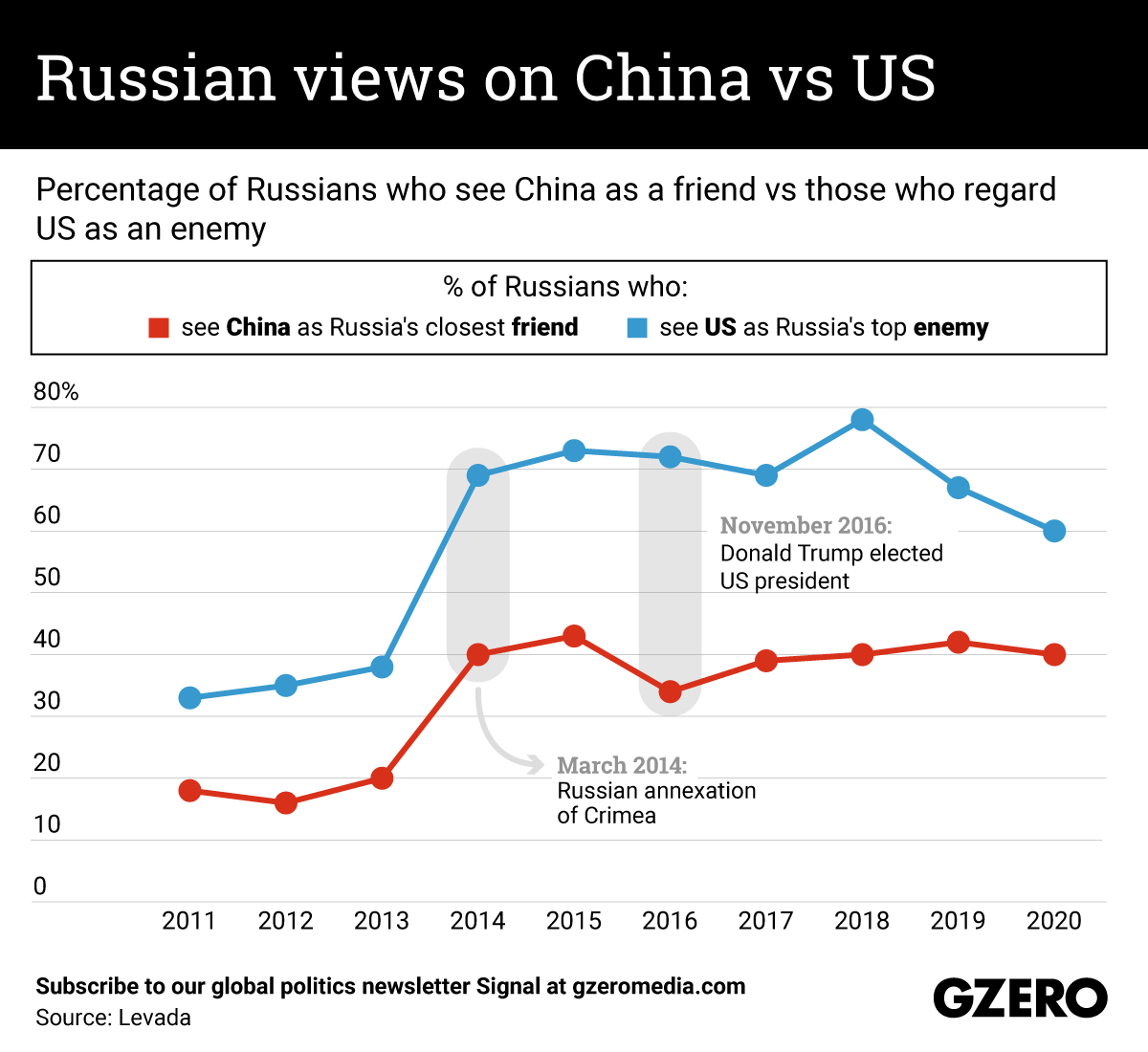
As both China and Russia have had increasingly adversarial relations with the US in recent years, Beijing and Moscow have found common ground on a wide range of economic and geopolitical issues. Interestingly, Russians' views of China and the US tend to move in opposite directions: during periods where the US is seen in a worse light, opinions of China tend to improve. That was notably the case in 2014, when Washington slapped sanctions on Russia over the Kremlin's annexation of Crimea. We take a look at how Russians' opinions on China as a friend versus the US as an enemy have evolved over the last decade.
From Your Site Articles
More For You
Can Washington turn military pressure into a diplomatic strategy? Brett McGurk joins Ian Bremmer on the GZERO World podcast to discuss the Iran war, Houthi attacks, and how elections in Israel and the US could reshape the region.
Most Popular
Think you know what's going on around the world? Here's your chance to prove it.
Turkish President Recep Tayyip Erdogan receives Canadian Prime Minister Mark Carney with an official ceremony in Ankara, Turkiye on October 22, 2026.
Anadolu via Reuters Connect
Canadian Prime Minister Mark Carney is in Turkey on Thursday for talks with President Recep Tayyip Erdogan - the visit is the first by a Canadian prime minister.
© 2025 GZERO Media. All Rights Reserved | A Eurasia Group media company.