
Podcast: Calling for the "reglobalization" of trade: WTO chief Ngozi Okonjo-Iweala
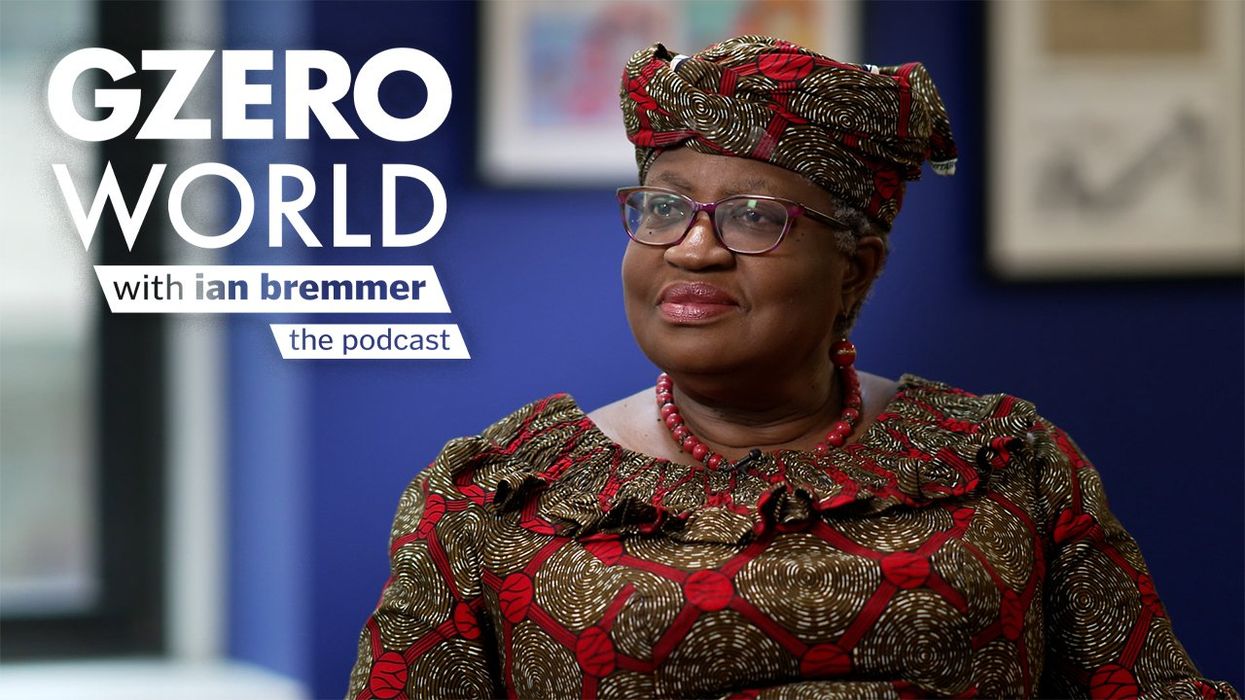
Listen: Ian Bremmer sits down with World Trade Organization Director General Ngozi Okonjo-Iweala, the first woman and first person from Africa to lead the organization, for a conversation about the good, the bad, and the future of global trade on the GZERO World podcast.
TRANSCRIPT: Calling for the "reglobalization" of trade: WTO chief Ngozi Okonjo-Iweala
Ngozi Okonjo-Iweala:
Globalization has lifted up more than a billion people out of poverty. What we need to do is not walk away from it, but reimagine it, to pull those who are left out from the margins into the mainstream of global trade.
Ian Bremmer:
Hello and welcome to the GZERO World podcast. This is where you'll find extended versions of my interviews on public television. I'm Ian Bremmer, and today we are talking about trade, the complicated business of moving goods and services around the world. Global trade hit a record 32 trillion in 2022 and the World Trade Organization overseas 98% of it. We don't know what happens with the other 2%. The WTO doesn't usually make front page headlines, that's probably a good thing, but it has a huge role in almost every aspect of your daily life. From your morning Brazil roasted coffee to the Chinese made smartphone that you're using to listen to this podcast.
The WTO has been a force for globalization, but it's also received criticism for favoring wealthy nations and exacerbating global inequality. Not to mention its broken dispute settlement system that's made resolving trade conflict, that's what it's supposed to do, virtually impossible. Can the WTO lower tension in US-China trade wars? Can it avoid further fragmentation? Can it effectively address the challenges faced by economies in the Global South? I'm talking about the good, the bad, and the future of global trade with WTO Director General Ngozi Okonjo-Iweala. Let's get to it.
Announcer:
The GZERO World podcast is brought to you by our lead sponsor Prologis. Prologis helps businesses across the globe scale their supply chains with an expansive portfolio of logistics real estate, and the only end-to-end solutions platform addressing the critical initiatives of global logistics today. Learn more at prologis.com.
Ian Bremmer:
Madam Director General, so good to see you.
Ngozi Okonjo-Iweala:
Thank you, Ian.
Ian Bremmer:
I want to start, we're here on the sidelines of the United Nations General Assembly, and you have been talking about the need for re-globalization. I'm wondering if you could explain to our audience, what do you mean by that?
Ngozi Okonjo-Iweala:
Well, thank you so much. We are in an era of geopolitical tensions and many people are very pessimistic about the impact of globalization. Globalization has lifted up more than a billion people out of poverty, but it's true that some have been left behind. Poor people in rich countries and poor countries have been left behind. With that in mind, and with the tensions we've seen with the war in Ukraine, the pandemic and all that, an emerging pessimism about whether globalization can deliver has taken hold. We're saying that, please, let's remember what this globalization has delivered. What we need to do is not walk away from it, but reimagine it, and reimagine how it can help to pull those who are left out from the margins into the mainstream of global trade. That's what we're calling re-globalization.
We're seeing opportunities where people see difficulties. Let me just be clear. We've seen the vulnerabilities of supply chains during the pandemic, and that has made people believe that we should re-shore, let's produce as much as we can at home.
Ian Bremmer:
At home.
Ngozi Okonjo-Iweala:
Let's produce with our neighbors, our friends, because that's the only way we can be sure. And I understand those sentiments, and we are seeing some of that re-shoring and near shoring. But then there's also the desire to build global resilience, not to rely too much on any one group of countries or any country to produce things. So I'm seeing people saying, "We want interdependence, not overdependence. We want to build global resilience." Well, re-globalization is a tool for building global resilience.
Ian Bremmer:
So when you hear both the Americans, President Biden and others, and the Europeans, Ursula von der Leyen and others, talk about de-risking, and they're primarily talking about the relationship with China, but it does reflect and factor into this idea of global resilience as opposed to national resilience, or resilience with your friends. How do you relate to that concept right now? The concept of de-risking?
Ngozi Okonjo-Iweala:
Absolutely. I actually think the de-risking language began to come up after we started talking of this issue of building resilience to re-globalization, of not throwing away the benefits. To me, de-risking, when I listen to President von der Leyen talk about it, is very similar to what we're saying. Let us build supply chains, decentralized supply chains to countries where the environment is good, but who have not been in the mainstreams of globalization. And many of those exist. People usually talk of China plus one, and the plus one will be Vietnam or Indonesia or India. But we've got other countries that have the right environment. What about Bangladesh? What about Brazil? Mexico is already in. What about in Africa? We've got Kenya, we've got Rwanda, we've got Senegal, and I could go on. I don't want to say my own country, Nigeria, which is the largest population.
Ian Bremmer:
You just said it. You just said it. Come on
Ngozi Okonjo-Iweala:
In East Asia-
Ian Bremmer:
And the largest economy in Africa by the way.
Ngozi Okonjo-Iweala:
And the largest... In East Asia, we've got Cambodia, which is receiving some of that investment, and Laos, so I could go on and on. What we're saying is let's look at others, other countries where the investment environment is right. Let's decentralize supply chains. It's not right that 10 countries export 80% of the vaccines in the world. It's too concentrated. Semiconductors, we know that that's also very concentrated. Rare earths and minerals, let's look, rare earths and minerals. There are many countries in Africa and Latin America that have these, let's decentralize and try to bring those countries' supply chains into the mainstream.
Ian Bremmer:
Global labor has also been very concentrated, right? I mean, for the period of globalization, China was a very big piece of, let's have the factory for the world. It's incredible amounts of inexpensive, very efficient labor. And you're right, some people in developed countries were displaced. But also, there's a lot of concentration risk. And I do think that some of this conversation is about, "Wait a second, we don't need as much labor as we used to. That labor is a lot more expensive than it used to be. Shouldn't we be building things closer to where the consumer markets are?" Irrespective of whether that's at home or not.
Ngozi Okonjo-Iweala:
Well, absolutely, Ian. You see, business, I mean, labor costs in China were already going up before the pandemic, and that is why you see a lot of businesses also moving to Vietnam to produce things, to take advantage of the cheaper labor there, the higher productivity. So even before all this disappointment, and the disruption we saw in supply chains, businesses were already making wise decisions based on the economics of what they could see. So we should allow businesses to make the wise decisions because I think they'll do the right thing mostly. Now, I think we may have to trade some efficiency to build resilience, meaning that we may need to diversify and decentralize production to many more countries.
Ian Bremmer:
So just-in-time was a little bit too efficient, if you will, too dangerous?
Ngozi Okonjo-Iweala:
Well, it played its role and the world benefited from it. Those supply chains, and the fact that you could manufacture goods cheaply, benefited consumers in developed countries. It was disinflationary. But now the time has come... Let me say one reason why I think we really need to pay attention to what we're saying, climate change. Climate change is wreaking havoc in so many places. If you concentrate your production in any one place, you risk really disrupting things. There are examples when there were floods in Thailand at one time and then the automobile industry was impacted by that. You see what is happening all over the world. So we do need to diversify if we want to build resilience. Diversified, decentralized production. But you are killing two birds with one stone.
Ian Bremmer:
Who are the champions? I mean, of course the WTO. But when you look at leaders around the world, who do you see as champions for re-globalization today?
Ngozi Okonjo-Iweala:
Well, I can tell you that Chancellor Olaf Scholz has been talking about, how do we decentralize the fertilizer supply chain? Just as an example. He's been talking about this very-
Ian Bremmer:
Really urgent, given the Russian War in Ukraine, of course.
Ngozi Okonjo-Iweala:
Exactly. That again showed the vulnerabilities of dependence on the Black Sea region for grain feed and fertilizer. So that talk about, how do we decentralize fertilizer production so that the world is not so dependent on any one region? That's what we're also talking about. There you also create jobs in countries that were not part of the global, let's say, fertilizer, or vaccine, or pharmaceutical supply chain. So why don't we think of that? Why is it that Africa, why must it import more than 90% of its medicines and 99% of its vaccines? 1.4 billion people. Why don't you decentralize production there? You create jobs for young people, for women, and at the same time you bring the countries there into the mainstream of trade and better integrate them. So we can kill two birds with one stone. So Chancellor Scholz is there, President Macron is talking about it, and also, the de-risking notion that President von der Leyen is talking about is very related to this re-globalization.
Ian Bremmer:
When I look at the first phase of globalization over the last 50 years, and I see that China became a huge winner through that, there was an emergence of a global middle class, so a lot of countries that were able to become middle income, most of Africa had not made it yet. When you're talking to me about imports of medicines, you're talking about vaccines, Africa hasn't yet globalized. What needs to happen at this United Nations General Assembly meeting? What needs to happen with the Africa Union being a part of the agenda for the G20 now they've brought in? What can we see in the next year or two, three, that would help, meaningfully, Africa to get on the path of globalization?
Ngozi Okonjo-Iweala:
Well, Africa, you're absolutely right, has about 3% of world trade, and that's too small. But Africa is doing some things that are pretty exciting. The African continental free trade area is an area of the 55 countries and 1.4 billion people. If... When, not if, that experiment really gets going, of Africans integrating better with themselves and trading, and creating a real market of 1.4 billion, equal to that of China and India, that is automatically very attractive for trade for the world. We need to remove the barriers to trade, reduce the costs, because trade costs on the continent are quite high. When you do that, I think that will make the continent much more attractive for investment and bring it into that margin. Then re-globalization can really begin to take place. So the continent has an instrument that it has put in place, we're very proud of that.
Many countries are trying to reduce cost. Actually, the WTO has a trade facilitation agreement, which is aimed at trying to reduce the cost of trade. If they implement that to the maximum, it'll really help to make the countries more attractive.
Lastly, we have an investment facilitation agreement under negotiations now with 110 of our members, many from Africa, that is designed to remove the barriers in the way of investment and make it easier. So the countries need to act, re-globalization will not arrive on your doorstep automatically. You need to make yourself attractive by removing the barriers to investment and trade, and then businesses will want to locate in your country. I think that this is on its way on the continent, so that's how we can get in. We now need to convince businesses that Africa is not the big risk. There's a perception that it's a huge risk to invest on the continent, and perception is running ahead of reality.
Ian Bremmer:
So we've talked about the impact of geopolitics on re-globalization. The WTO, of course, is also caught up in some of this. Since I have you here, Ngozi, I have to ask you about the broken dispute resolution settlement mechanism, and that the Americans have been holding up the appointment of appellate judges. Supposedly, reform needs to happen of the WTO before they're willing to make that happen. Is that moving forward?
Ngozi Okonjo-Iweala:
Yes. Yes, it is. First, just to correct one thing, the system is really not broken, it's two tiers. There's a panel level, and last year, 17 cases were brought. And cases are being brought every day.
Ian Bremmer:
And they get resolved at the panel level.
Ngozi Okonjo-Iweala:
Yeah. The panel gives a judgment. The problem we have is, quite rightly, like you said, Ian, the second tier, the appellate body, is not functioning, because as you said, the US blocked the election of judges into that tier. So what happens is if there's a "judgment" against a member, they can appeal it into the void, since that second tier is not functioning. And it's very crucial that it functions, because if you negotiate agreements, it's not good that the mechanism for enforceability doesn't work well and smoothly, so we are reforming it. The US has been very constructive now and they have laid out what their problems are with the system. We have a process ongoing at the WTO. We hope that by the time we have our 13th ministerial meeting in Abu Dhabi-
Ian Bremmer:
Next year, yeah.
Ngozi Okonjo-Iweala:
Yes, end of February 2024, that we would've gone a substantial way towards agreeing on this reform and the form it should take. So work is visibly underway, and I'm hopeful. I don't want to be too hopeful, but I'm hopeful that we will go a long distance in this reform.
Ian Bremmer:
Does that mean that next year, more likely than not, we actually will have a breakthrough of this impasse on the appellate court?
Ngozi Okonjo-Iweala:
I'm hoping so. Actually, at our 12th ministerial, June last year, members signed on the dotted line to reform of this well-functioning dispute settlement system by 2024. I think the issue now is, when in 2024? And we're trying to say, "Let's get it done by February when we have this ministerial meeting."
Ian Bremmer:
Well, we're very litigious in the United States, so we want to be able to bring people to court. Let's get this resolved.
Ngozi Okonjo-Iweala:
Let me tell you that the US is one of the biggest users of the system, and they've won the most cases. They've also lost, but they've won more than they've lost. So we hope that... Some of the complaints they're making are legitimate. They're not the only ones who have problems with the system, developing countries also find it difficult to access. So let's take all these complaints, let's try and reform the system and make it useful to everyone.
Ian Bremmer:
Madam Director General, thanks so much for joining us today.
Ngozi Okonjo-Iweala:
Thank you, Ian.
Ian Bremmer:
That's it for today's edition of the GZERO World podcast. Do you like what you heard? Of course you did. Why don't you check us out at gzeromedia.com, and take a moment to sign up for our newsletter, it's called GZERO Daily.
Announcer:
The GZERO World podcast is brought to you by our lead sponsor, Prologis. Prologis helps businesses across the globe scale their supply chains with an expansive portfolio of logistics real estate, and the only end-to-end solutions platform addressing the critical initiatives of global logistics today. Learn more at prologis.com.
Subscribe to the GZERO World Podcast on Apple Podcasts, Spotify, Stitcher, or your preferred podcast platform, to receive new episodes as soon as they're published.