Skip to content
Search

Latest Stories

The Graphic Truth: How free is the internet?
The Graphic Truth: How free is the internet?
Make us preferred on Google

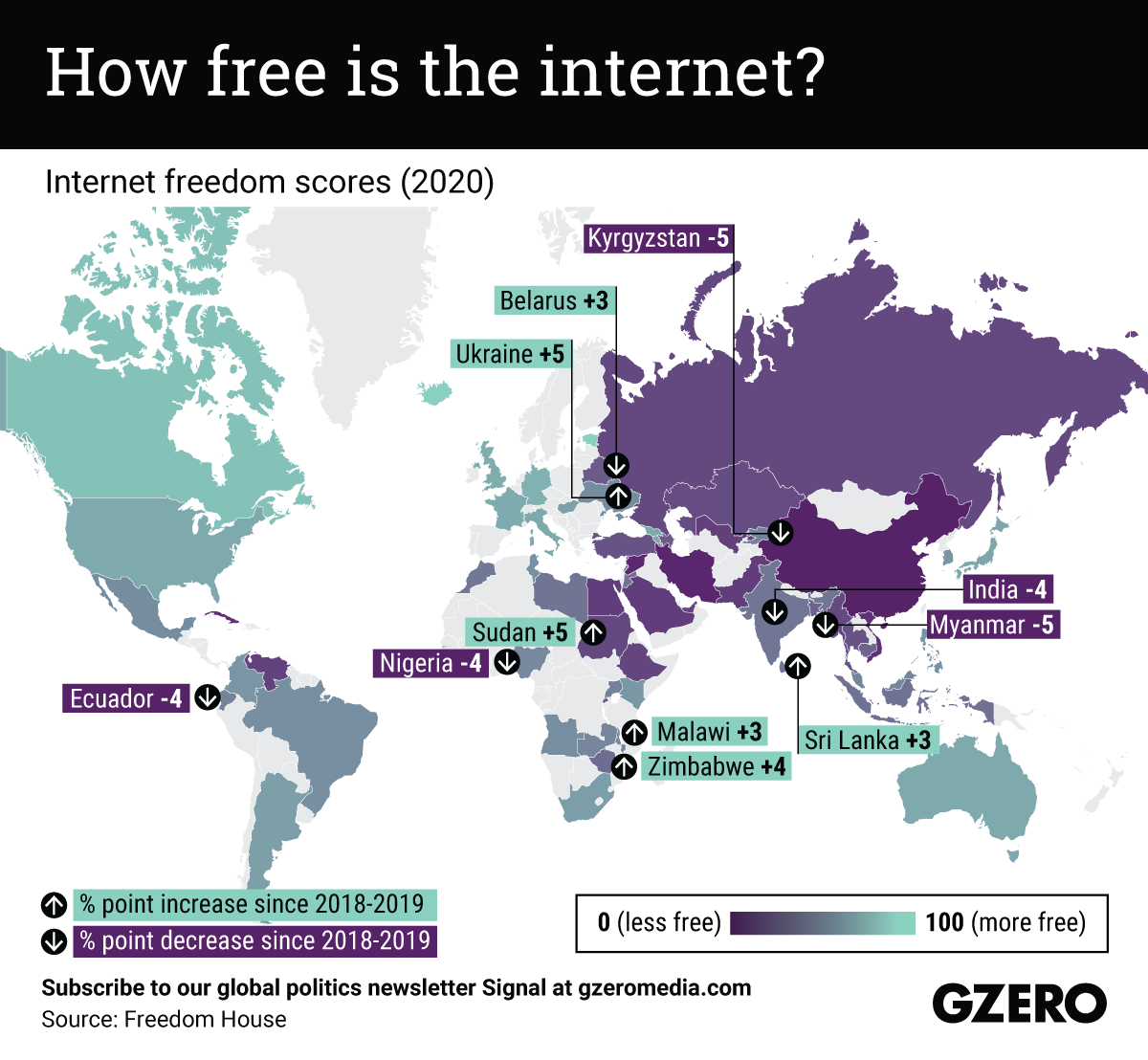
As more human activities go online to prevent the spread of COVID-19, the coronavirus has actually made the internet less free than before in many parts of the world. Freedom House warns that political leaders are using the pandemic to suppress access to information under the guise of combating fake news, to justify online surveillance that otherwise would be deemed too intrusive, and to break up the World Wide Web with so-called "cyber sovereignty" regulations that are drawing national borders on the online distribution of information. We take a look at the state of internet freedom in 68 countries, highlighting the top five that have improved and declined the most.

More For You

Residents dig through the debris of a collapsed building after an earthquake.

Residents dig through the debris of a collapsed building after an earthquake, in Cali, Colombia August 10, 2026.

REUTERS/Juan Pablo Arbelaez
Earthquake rocks Colombia days into new president’s termA 7.4 magnitude earthquake struck Colombia yesterday – at least 160 people have died, though officials expect the toll to rise as rescue efforts continue. The quake’s epicenter was in the Chocó region – one of Colombia’s poorest areas that has also been wracked with clashes in recent years [...]
Zambia’s elections put its democratic reputation to the test
Will Fitzpatrick
Zambians head to the polls this week in national elections that will test a country that’s garnered a reputation as one of southern Africa’s most stable democracies. Since Zambia returned to multiparty elections in 1991, it has had six different presidents from three different parties. President Hakainde Hichilema is seeking reelection after [...]
Demonstrators participate in a nationwide protest against data centers, in Fredericksburg, Virginia, U.S., July 18, 2026.

Demonstrators participate in a nationwide protest against data centers, in Fredericksburg, Virginia, U.S., July 18, 2026.

REUTERS/Evelyn Hockstein
In 2019, GZERO reported on a brewing backlash against AI’s facial recognition and surveillance capabilities. Seven years later, opposition to the technology, which has advanced dramatically since then, is intensifying. A survey of more than 18,000 people in 15 countries found that over one-third ranked AI development among their top concerns over [...]
Aliens invade the Regime!
- YouTube
They travelled more than a hundred million light years to find us. It didn’t go as planned.Watch more PUPPET REGIME! [...]